Classic rock

(2014)

You get to a certain age and your friends stop pretending they never liked Stevie Nicks. I wish I’d never brought it up. It was bad enough hearing how great Heart was. The radio was on some classic rock station in the kitchen as I washed a zillion Thanksgiving dishes a couple nights ago. Eddie Money came on. No. Absolutely not. I reached up with a sudsy hand and switched it off, thinking that in a room full of my old punk rock and jazz buddies, half the punks would confess to always liking that song, and half the jazzers would have been on the session. He seemed like a cool cat, they’d say. I’d relent and let the punk rockers sing Two Tickets to Paradise. Air guitar. Oh god.

.

The coolest damn thing

(Brick’s Picks, LA Weekly, 2006)

Sometimes it must seem like we’re rattling off the same names here week after week, but what so special about jazz (or any improvisational music) is that you’re never seeing the same thing twice. That’s the whole point of the stuff. A player might call out the same damn tune every week, but it won’t sound the same as it did the week before, or the week before that, or the week coming up. And more than likely several players across town are calling out the same damn tune on the same night, but once past the head (that is, the patch of melody at the beginning that you’ll recognize) it’s all unexplored country. A more educated writer could explain how and why, but we’ll just say that while you need to know that stuff to play the things, you don’t need it at all to hear it, and to dig it. Just listen as a soloist spins a story through his horn. It might be the prettiest thing you ever heard, or the bluesiest, the saddest, the strangest, the most romantic, the most visceral. But if you listen to it, and then feel it…you’re on to something. You’re on to digging what is to be a jazz fan, and just how good it feels to me moved by a solo, or be amazed at how players—the people on piano, bass, drums, the horns—make interweaving patterns, vibrant dynamic things, sounds you can almost see unfolding before you, and how they all come back together again at the head, that is where the melody of the tune suddenly reasserts itself. And that is the coolest damn thing.

Hipped to a couple books

(Brick’s Picks, LA Weekly, 2006)

And we’ve been hipped to a couple books that’d make some cool xmas gifts ideas. Bari blowing/beatnik looking/mystery writing Skoot Larson’s The No News is Bad News Blues is a fun read; his trumpet playing, hard drinking, weed smoking, record collecting accidental detective Lars Lyndstrom stumbling into a terrorist plot. Fans of Bill Moody’s Evan Horn books will dig it. Moody’s tighter and leaner, but Larson’s storytelling is like a free ranging live jazz session. And if you know San Pedro (or Oslo) at all you will love the settings. Peter Levinson’s Tommy Dorsey: Livin’ in a Great Big Way is a terrific read. The Big Band Era was a whole ‘nother universe, and don’t fall for the “innocent times” stuff our parents/grandparents dropped on us. These guys lived hard, played hard, worked hard, fought hard and (in Dorsey’s case) died hard. The book bear up the legend: T.D. was not an easy man to know, let alone play for (or worse yet, be married to.) But he sure could play some pretty trombone. Those were amazing times, with the music, the arrangers, the tours, the War, the movie stars, the kids, the dancing, the partying, and the segregation and desperate poverty that so many players, white and black, Irish and Jew, rose from. Levinson’s energetic prose brings the era vividly back to life.

Med Flory

(LA Weekly, 2005)

On 52nd Street alto saxophonist Med Flory once gave Charlie Parker his last five dollars. Bird paid Flory back bigtime, though, when Med arranged his solos into Supersax. Bird…Med’s eyes light up. The wisecracks cease. He’s one of the kids who heard “Ko-Ko” and flipped. Parker revealed whole new dimensions, musical universes. So what if bop drove the folks away? The hell with popular shit. On this night John Heard will anchor the rhythm section, guests will sit in, Carl Saunders will play miraculous trumpet. The sets will be bop, blues, maybe a casual vocal. Med’ll sit on his beat-up sax case, take a deep breath and blow like a crazy mother, eyes wild, lost in progressions. Then, remembering it’s his 79th birthday, he’ll come up for air, wiping the sweat from his eyes. “I just love to play, man” he’ll say, as the pianist unravels the melody.

Jazz just seemed alive.


(pulled from an emailed essay, 2004)


I came across a great stash of jazz albums on Saturday for real cheap. One of them was a bunch of Jimmie Lunceford sides from the late thirties and early forties. I was listening to it Sunday morning, and reading the notes that talked about Central Avenue and the Dunbar Hotel, and Gerald Wilson, and on the back there is a great shot of the band from 1941, including Snooky Young on trumpet. By that afternoon I had completely forgotten all that , of course, in the middle of all the people and music and heat of the day at the Central Avenue Jazz Festival. Even while walking through the lobby of the Dunbar Hotel and looking at the pictures it hadn’t occur to me. The Gerald Wilson orchestra took the stage a few hours later, and during the first number, a Basie tune, Gerald Wilson calls out the first soloist: Snooky Young. He stood up there in the back and blew hard, and with that plunger in hand his horn was talking, telling some old, old stories. I’d seen Snooky Young there before, of course, probably every time I’d seen the Orchestra play this Festival. But having seen that picture that very morning, and listening to him solo on that old wax and then here in person, in front of me: it was different. That ephemeral connection to the old days, what I’d known only as history, suddenly became very real. Maybe it was the sunset breeze kicking up but for a minute there I felt a chill. Like watching an old black and white photo turn into color and start moving. Making history real. Jazz just seemed alive, all of it.

Jazz and hockey


(2002) 

A couple seasons ago I dropped by a local spot called Jax to see the Eldad Tarmu Quartet. He plays the vibes, and I’d come across his great Aluminum Forest in the local record shop for two bits, so I was thrilled to see them at Jax just down the street and over the river in Glendale. As the band was setting up the television behind the stage was showing a Kings game. The bartender had forgotten to switch it off and as Eldad & Co. went into some crazily tempo’d piece I continued watching the game behind them. It was a perfect soundtrack. I had always suspected it, and had watched games soundlessly at home with jazz on the stereo, but here was live proof. At one point it was four-on-four on the ice that matched the four players on stage who, just for a moment, were actually trading fours. I watched astonished. Eventually the bartender switched the television off and I concentrated on the actual performance. But man, the energy of small group bop and hockey was such a perfect fit, at least to this addled mind. Hell, it was beautiful.

Super Bowl

(Super Bowl Sunday, 2014)

Saw an incredible hockey game yesterday morning. Back and forth, until they piled up a five-five tie and a frenzied overtime finished it off with a terrific Caps goal. Detroit slunk off, so close but so far. I love hockey, and that was a game, man, that was a game. No pathetic blow out. No horseshit music at halftime. No insanely expensive commercials. Just two hockey teams playing like their lives depended on it while the audience sat on the edge of their seats.

Some sports are real. And some sports have degenerated into show biz.

This isn’t the kind of thing you’re supposed to talk about on Linked-In. But they were. A site that’s all about business and commerce and ratings and climbing up the ladder, and everybody is talking about the Super Bowl, and especially about the commercials. Sports as seen through commercials. Or maybe commercials as sports. I know there was actual sports involved. There were two teams and a cloud of Astroturf dust. Apparently, on LinkedIn, that was incidental to the real action, the commercials. I thought about the hockey I’d seen the day before. Those teams showed up on that ice yesterday to play a hockey game. These teams seemed to show up at the Super Bowl to sell Budweiser and Doritos. What was the score, 43-8? That’s not even a contest, not even pretending to be. That’s just a bunch of guys running around a field to fill in time between commercials. And I didn’t even watch the game. I read about the commercials in the news. In fact I read about the commercials before they were even aired. Somehow people have made a contest out of the commercials. There was pre-game debate about who would have the best commercial. Stop and think about that.

Or stop and think about this: “The ad touched the depths of my soul,” says Char B., a middle school language-arts teacher from Livonia, Michigan, on LinkedIn. “Nothing reaches raw emotion like the love of animals.”

A beer commercial touched the depths of her soul.
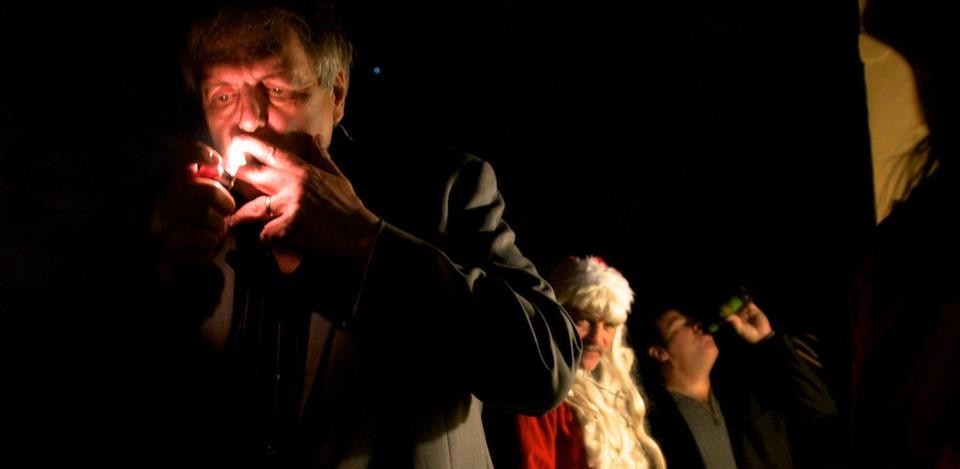
Shadow of the Vampire

Shadow of the Vampire. John Malkovich has to have the worst fake German accent of all time, worse even than Marlon Brando in the Young Lions. You think they could have cut back on Malkovich’s specialty catering needs and brought in a dialog coach, or at least combined them. Or maybe they did, and it didn’t work. This is Münchner Weißwurst, Herr Malkovich. Munchy Wice wirst? Willem Dafoe, however, is one of my fave vampires ever. You think that someone would make a NetFlix mini-series based around that dirty old decrepit vampire. AARP could sponsor. Dracula Is Trying to Rise From the Grave. Dracula Has Fallen and He Can’t Get up. Unbeing John Malkovich. Which makes no sense, I know, but it’s been a punchline in search of a set up for years.

Some cat copped my shit


(2013)


Drag, man, sorry you lost your shit but that shit went up somebody’s arm a long time ago. Can’t trust nobody nowadays. Cats robbing each other blind. Turn yer back for a minute and your shit is gone. I knew a cat so messed up he ripped off his own horn in the middle of his own solo. Pawned it, scored, fixed, stole another cat’s horn, pawned that, got his own horn back and finished his solo before the drummer even knew he was gone. True story, man. Anyway the cat drops out for the bass solo, nods out, wakes up in time for the drum solo. But there is no drum solo. Someone had stolen the drummer. So he grabs his horn again and gets ready to blow but nothing. The trumpeter had stolen his solo. He’s playing it like he owns the thing. Then my man looks up and sees his wife leaving with a tenor player. Shit. So he blows a solo he stole from the tenor player, and the bass player comes in, and the drummer is there again, and they take the tune back to the head, except someone stole that, so they just did a quick “Salt Peanuts” and went out to connect.

But I hope you get your shit back. How much you say it’s worth?

Tony Gieske, writer

(2014)

Tony Gieske is gone.

So sorry to hear this. Heartbreaking even. Great guy, hardworking journalist, wonderful story teller. In my opinion, Tony Gieske (who died in February 2014, aged 82) was the best jazz writer on the planet. Perhaps the best ever. I’ve never read anyone better. He knew jazz, he knew language, and he knew how to combine the two. I can think of no higher compliment for a jazz journalist than that.

Tony Gieske was a double whammy, a brilliant writer who could also take some terrific photographs. Rarely do the two mediums meets as well as they do here. A jazz review hidden inside some story telling, wrapped around a thousand words worth of a photograph that absolutely nails what he says with the prose. Dig that opening: “You would never say that Sal Marquez was off the scene. He’d just be on some scene not yet up to you.” The way he takes a hipster cliché and twists it open, and you see just how much hipper Sal Marquez is than you could ever be, dear reader.

And then a couple hundred words later, the closing: “And he kept finding fresh paths past beautiful flowers, as did the rest of the players, converging often enough with each other to attain salutary bandhood.” You know, I wrote a quarter million words or more for the LA Weekly and never once did I think up ‘attaining salutary bandhood’. Not once.

Tony was one of those exceedingly rare creations…a jazz journalist whose skill with words was equal to the musical skill of the people he wrote about. I wish there were more like him, but those like him are novelists or short story writers or penning beautiful pieces for the New Yorker. Guys like him don’t write about jazz. Why would they. You’d have to absolutely love a music more than almost anything to spend a life writing paeans to it that will be seen by few and appreciated by fewer. It’s a ridiculous vocation, this jazz writing. We talked about that a few times. About how crazy it was to write jazz reviews. But then we’d change the subject, or a pretty lady would walk by, or somebody’d start soloing and we’d stop everything and listen. Listened and listened. Listened without saying a word, as the saxophone was doing the talking. Later he’d put it into words so you could hear that sax talking too, even if you were not there.

That’s what jazz writers do, and he was one of the very best.

The Sal Marquez Quintet at Spazio by Tony Gieske (International Review of Music)

You would never say that Sal Marquez was off the scene. He’d just be on some scene not yet up to you. So here he was now, and what a scene to be back on, at Spazio or wherever.

Rick Zunigar was playing a solo on guitar concerning “What’s New.”  Bright ideas were flooding down like seagulls on a sandwich. He has absorbed much from his hero, Joe Pass. It was not terribly far from the sublime.

But then so was the output from Chuck Manning’s tenor, more high velocity goodies in a sound somewhere south of Stan Getz and north of Lester Young, in a room of his own.

Neither soloist asked quarter from the rhythm section, drummer Steve Hass and bassist Chris Colangelo, and none were they given. Tight but bumptious, these two stayed pure and musical.

Marquez called the plays after brief huddles with his bandmates, naming such rich and seldom mined veins as Joe Henderson’s “Ice Truck,” a jump tune, or challengingly familiar ballad fodder such as “If I Were a Bell.” A veteran of the bands of Frank Zappa, Buddy Rich, the Tonight Show and many other enviable gigs, he has plenty in his pantry.

On “Bell,” Marquez eschewed the approach of his one-time idol Miles Davis. Now he was cavorting all over on a foundation we used to hear under Freddie Hubbard. But Marquez’ sound is warmer, gentler and more thoughtful than in the past.

And he kept finding fresh paths past beautiful flowers, as did the rest of the players, converging often enough with each other to attain salutary bandhood.

Sal Marquez and Chuck Manning at Spazio. A perfect jazz photo by Tony Gieske.

Sal Marquez and Chuck Manning at Spazio. A perfect jazz photo by Tony Gieske.