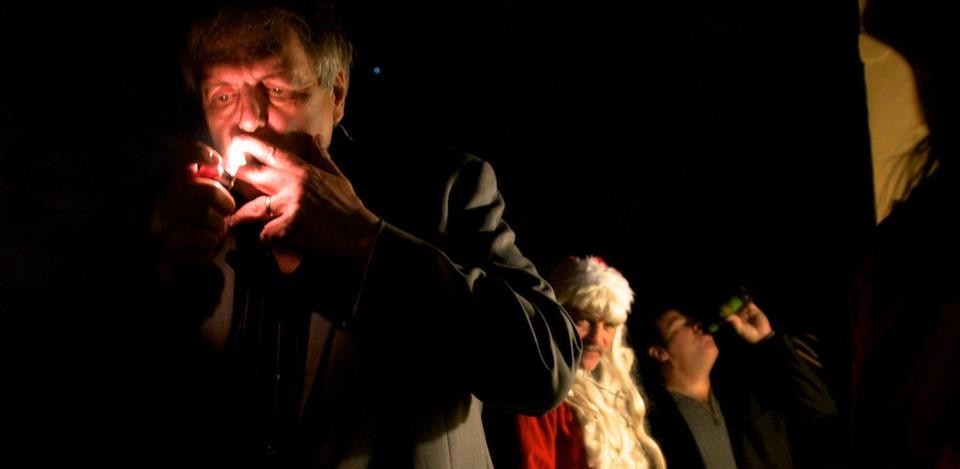
Interesting bit in The Third Man that few probably pick upon anymore…after Holley Martins (Joseph Cotten) first meets Baron Kurtz, they go walking down the sidewalk together. Kurtz has vaguely Mediterranean features and it dawned on me that the character might be Jewish. It had never occurred to me before because Austria had been thoroughly Judenrein by an especially efficient Nazi administration. Apparently this Kurtz would have been one of those who had either survived the death camps or been in hiding in Vienna for six long years. Now he was making his living in a vaguely Fagin sort of way, Graham Greene falling back on an old and cringeworthy English literary trope. Then again, perhaps I was imagining all this. Perhaps Kurtz represented some sort of Austro-Hungarian Balkan-Mediterranean blend. After all the Hapsburg empire, though officially German speaking (outside of Hungary, but that’s another story), had been a swirl of ethnicities, never been even close to the Germanic stereotype. If you listen you can even hear bits of Italian in the German dialogue, unthinkable in Berlin. Now we watch Baron Kurtz and the Joseph Cotten character walk down the street. An Austrian policeman on his beat walks toward them, still with a Gestapo-ish hint of a Hitler mustache. The cop pays no attention to either of them, nor does Holley, with his American film noir disrespect for cops (I hate coppers, as Cagney seemed to always say), pay attention to the cop. Kurtz does, however. He looks up, sees the cop, and with the alacrity of experience steps out into the street. The cop passes and Kurtz gets back on the sidewalk. What might be taken for a little common sense courtesy had, I’m sure, a much darker meaning. Nazi law forbade Jews to walk on sidewalks. Jews on sidewalks were beaten. In Riga they were killed on the spot. I saw that microcosmic scene within a scene, those few steps, and knew that Kurtz was Jewish. Sometimes a few seconds of film illuminate vast crimes and unspeakable tragedies, throwing shadows you never noticed before.
Category Archives: Movies
About me
TCM is weirding me out. First there were giant ants in the river behind me. Now there’s a guy named Brick bossing John Wayne around. Next up is the Thin Man, which I haven’t been in a long time. Then a loser writer in the Third Man, Thirty Seconds Over Tokyo and I do little enough as it is, and finally A Thousand Clowns, about a do little writer. What is Robert Osborne trying to tell me? If this is narcissism, you can have it.
The Commercial Advertisement Loudness Mitigation Act
(2012)
I keep falling asleep on the couch during the midnight movies . . . last nite it was On the Waterfront, my fave flick ever. I couldn’t figure out why . . . after all, one of my seizure meds discourages sleep even. Then I read Greg Burk’s latest MetalJazz and he’s going on about the Commercial Advertisement Loudness Mitigation Act. CALM for short. Clever. He’s crazy about it. No longer can commercials be louder than the programs they’re interrupting. You can imagine Burk before its passage, in his EZ chair, lunging for the remote and cursing the Toyotathon. No more, though…all is mono-volume, smooth and unsurprising as the Kansas plain. The law went into effect on December 13, about the time I began dozing off before Marlon Brando had a chance to tell Rod Steiger he coulda been a contender. I am lulled into deep sleep curled up on the couch, surrounded by the new fluffy couch pillows (which don’t help things either). Marlon Brando and Rod Steiger and Ashley Madison and the Mattress King flowing seamlessly together. Nothing interrupts. No more being jolted awake by those ads for the Trojan Twister and their haunting undertone that men aren’t really necessary at all. But the thing is, I always did my best writing in the wee hours, invariably after being awoken by that delicious babe describing hideous malpractices that can be sued for. She rattles them off, all kinds of scary things, diseases and deformities and even death. She talks so fast, this chick, and never blinks. Disturbing. And I don’t even know what a vaginal mesh is. So I’d turn off the TV and turn on the computer and out would come prose. All kinds of prose. A blog’s worth of prose. No more. Now I just sleep, wake up, straighten up the house (I always straighten up the house), read a while and go to bed, the real bed, and sleep again. No prose at all.
There goes my writing career.
The People vs. Norman Flint
“And those who were seen dancing were thought to be insane by those who could not hear the music.” Friedrich Nietzsche
Damn, that’s a beautiful line. A little romantic maybe, but beautiful. Very much the Europe of la Belle Epoque. Vast wars are still in the future, ancient empires intact, and even weirdos were harmlessly dancing. Sweet. Nostalgic. Flowers in the rain.
Of course, Nietzsche wound up completely insane. Utterly mad. Which led me to wonder about his quote. It didn’t sound like Nietzsche. “That which does not kill us makes us stronger.” Now that was Nietzsche. And it didn’t sound like German, either. “You have your way. I have my way. As for the right way, the correct way, and the only way, it does not exist.” That sounded German, with the verb sitting there solidly at the end. “And those who were seen dancing were thought to be insane by those who could not hear the music” lilted. It’s musical. In rolls off the tongue in English and English has rolled off the tongue like that since the Normans dressed up our west Germanic language in layers of French finery. English and German deep underneath are quite the same. But we’ve moved a few things around, softened a lot of consonants and dipthonged every vowel we could get our hands on, and eventually our language developed a bit of a lilt–not a swish, certainly, but definitely a lilt–that pries it free from the German so far that you have to hit bedrock before you realize it’s a Germanic tongue you are speaking. But I’m digressing from my point that “And those who were seen dancing were thought to be insane by those who could not hear the music” just didn’t ring German to me.
So I googled it. I found the same quote and same Nietzsche attribution everywhere, on site after site. Dozens and dozens, all the same. It’s one of those things that makes romantics swoon. Then, several Google pages in, I stumbled onto a site called Quote Investigator, whose quote investigator wrote a long and magnificent account of his elaborate investigation that established that it was definitely not Nietzsche, nor any of the myriad other people to whom it was attributed, including Anne Louise Germaine de Staël, John Stewart (not Jon Stewart), a science fiction fan, Angela Monet, the great Sufi philosopher Rumi, some more science fiction fans, George Carlin, or Megan Fox, who had it tattooed on her back which would give her away instantly should she be the victim of a celebrity sex tape. My favorite choice was a mysterious someone named Norman Flint. I love that name–Norman Flint. No lilt there.
The thing has been attributed to everyone, even just an unknown (“anon.”) . In fact now someone will attribute it to me if they are high enough and only look at the first two sentences of anything they see online, which is what stoned people do. Then they babble knowingly to their friends and urban myths are born.
Anyway, it turns out that back in 2005 a newspaper in Florida said it was Nietzsche. They probably found that on the internet which has since collectively settled on Nietzsche, so it must be true. Alas, it ain’t, and our dogged quote detective finally throws up his hands and admits he has no idea who said it. He even added a mess of footnotes to show how he tried. Several commenters chimed in with their theories of their own (none, alas, Norman Flint.) Then came this:
“And those who were seen dancing were thought to be insane by those who could not hear the music” is a translation from one of the lines in a French play called The Madwoman of Chaillot. It’s a fabulous play about living a life free from the pollution of money and all the dark, needless things that cause life to become dreary.
That rather nails it. The Madwoman of Chaillot (La Folle de Chaillot) written by French playwright Jean Giraudoux in 1943, first performed after the Liberation in Paris in 1945, though Giradoux himself died (no word on how) in 1944. Apparently it’s a satire, so I’m not sure if those who were seen dancing were thought to be insane by those who could not hear the music was as overtly romantic as it appears to be all over the Internet. I suspect a subtlety or layered meaning but I can’t tell without reading the original (or the English translation, anyway). Alas, after some dogged googling myself it seems the play does not seem to be online, nor a script of the movie (starring Katharine Hepburn, Paul Henreid, Oskar Homolka, Richard Chamberlain, Donald Pleasance, Danny Kaye and Charles Boyer) that came out in 1969. That’s a powerhouse cast–and besides Boyer there’s dozens more French cast members as well–for a film that no one seems to have heard of anymore. Weird how that happens. But maybe Turner Classic Movies will show it. Or maybe they already have. So is the line in the movie’s script? I found a site that contained an online version of the screenplay…but it was gone. Poof. Funny how sites disappear like that, and right at critical moments. Makes you wonder about conspiracies, or bad luck, or meaningless chance. Something. Or maybe someone, who wants us not to know. There’s a danger in being a man who knows too much. Que sera sera. But Doris Day is not in The Mad Woman of Chaillot. You can look that up for yourself on the International Movie Database. IMDB don’t lie, baby. You can set your watches by that. Plus IMDB lets you look for crazy credits, those wacky, zany things. There are no crazy credits for The Mad Woman of Chaillot. The French are very serious about these things. A lady probably takes her top off, though. You can’t make a French movie without a lady taking her top off. It’s the law.
You can watch the flick online. If you watch it you might hear the line in question. Katharine Hepburn would say and those who were seen dancing were thought to be insane by those who could not hear the music. Unless it was Richard Chamberlain, who would say it in a perfect monotone that sounded so grave and sexy that all the ladies would want to make mad love to him right there on the spot. That’s what I think. Someone check with Robert Osborne. Though maybe if you had the right English translation of the play itself it’d be there, just like the commenter said.That would nail the answer in a heartbeat. That’s what I think.
But this is not quite good enough for our dogged Quote Investigator. He wasn’t so sure. Do you know the specific part of the play that you believe contains the statement? he asks. Do you know which character makes the statement, or what phrase was used in the original French? A good quote investigator is always suspicious. False flags and prevarications lay across the internet like mine fields.
Of course, he could have found out for himself by going to the library, or even calling a library information desk. My friend Linda works at the library. You could call her, she’d research around, and if they have the book she’s hold it aside for you. You wouldn’t even have to check it out but sit there quietly and read till you found the quote and shout Voila! Then Linda would bop you on the head. No shouting in the library. But you would have found your answer and set civilization at ease. Which is a good thing. That’s what I would have done. Called the library and then gone down there and found the quote. I wouldn’t shout Voila! though. Linda would bop me twice as hard and then tell everybody we know. Imagine my shame
But our dogged quote investigator would probably not even bother. No one goes to libraries anymore, he seems to hint. No one reads books, let along plays. What’s the point? If it’s not on the internet, it can’t be true.
Which is why I still think it’s by Norman Flint.
The Arrival
Movie nite at Chris P’s last night. The Arrival, which I dug muchly, though at the nerdiest part of the whole picture the characters were discussing the Sapir-Whorf hypothesis and I realized to my silent dismay that not only was I familiar with the Sapir-Whorf hypothesis but I know who (as opposed to what) Sapir-Whorf were (the former was the only other person in the world who could converse with Ishi in his native tongue, the latter was in the insurance business, like a linguistic Wallace Stevens). Even worse on the nerd scale, the book I’m completely absorbed in currently also discusses the much maligned but recently revived in some circles Sapir-Whorf hypothesis, making Noam Chomsky so mad you wouldn’t believe it. Basically, do not get stuck sitting next to me at a dinner party. As the film went on it was obvious that neither the story’s author nor the screenwriters were Chomskyan, and Chomsky himself would have gone transformationally grammatically/ideologically apeshit at the vaguely hippieish blend of linguistic relativism and Sino-fascism. Not that he would ever bother to see the film. He’d send some grad students.
Personally, though, I dug it. The last time I saw linguistics in science fiction it was a cookbook.

Road to Singapore
Road to Singapore. Too many ad libs and not enough sub plots. You can actually tell what’s going on. Plus no CGI. And the jokes work. All these extras could have been perfectly good minor characters within a miasma of irritating subplots. What a waste.

Albanian amateur porn
A clip of Albanian amateur porn in my email. That’s what it said: Albanian amateur porn. I have no idea how one tells the difference between it and any other Indo-European porn. How the world has changed, I thought. During the Cold War it was at its very coldest in Albania. They didn’t shoot porn there. They shot Albanians, mostly, or anyone unlucky enough to stumble across the border. Albanians also built bunkers and pillboxes by the hundreds of thousands, till they littered the countryside like mushrooms, completely useless. Now they house chickens and sheep and their kid’s heavy metal band. No one did ever invade Albania, though. Maybe the useless things actually were a deterrent somehow, scattered helter skelter across field and beach, city and mountainside. Apparently when America or Italy or Yugoslavia or the USSR or whoever invaded, all Albanians and their sheep were to take to the bunkers and defend the Revolution to the death. It never happened. Instead, Albania’s own Stalin (or was it Mao), Enver Hoxha, finally died and was forgotten. I thought of him as I deleted the video unwatched. I can’t imagine Albanian amateur porn is any less clumsy or badly filmed than any other. People of all nations are busily humping away in front of their iPhones anymore, millions of them, thunder thighed and shaven all over, to the intense embarrassment of all their children not yet even born. Though maybe they were born nine months later. Oh no, look, it’s Mom and Dad. The things those of us old enough never had to worry about, let alone imagine.

Before they made amateur porn, Albanians built 700,000 bunkers like these.
Man in the Middle
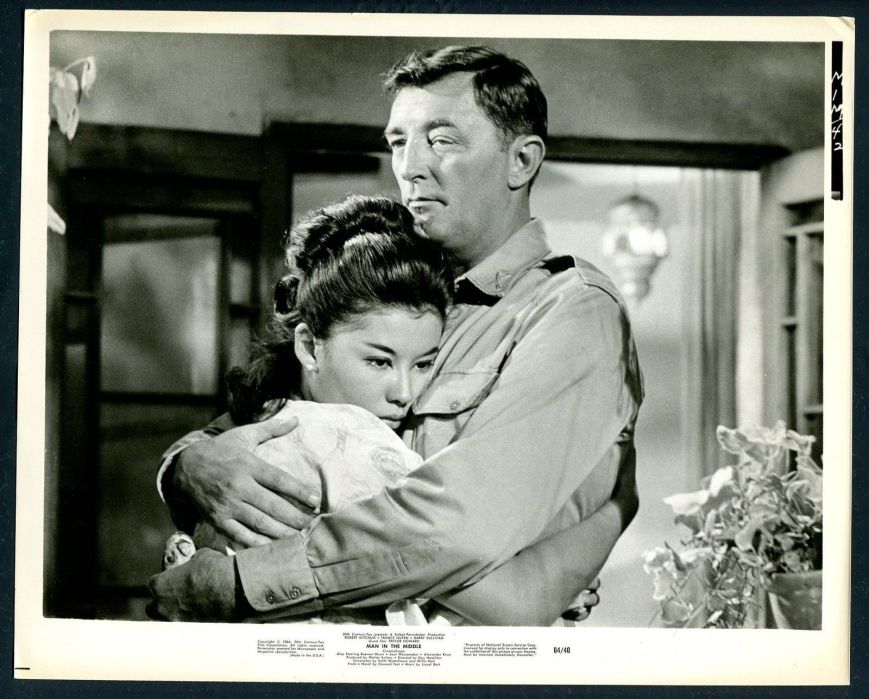
I give up. I saw that Man In the Middle was on again last night, so I watched it. My fourth attempt. It’s not the greatest flick, but it’s a Robert Mitchum movie, so it’s obligatory alpha male viewing. Trevor Howard just ups the ante. Mitchum plays an army lawyer defending American soldier Keenan Wynn (another manly man) who murdered a British officer, apparently a crime. It’s in India, far from the front, and everything is tropical and sticky and noir. Fraffly hot. At some point Mitchum winds up at France Nuyen’s pad in the middle of the night. She comes to the door in a negligee. (It’s opaque, settle down.) They talk in abstractions. Mitchum, torn between moral dilemma and tough guy not giving a fuck, smokes his eight hundredth cigarette of the film. France Nuyen wafts about in the hot night air, her accent oozing impropriety. If you want to rest your conscience on my pillow, she purrs, that is alright too. Her clipped francophone Vietnamese pronunciation hints at a zillion vowels and tones missing in English. Mitchum digs it and almost emotes. They are all over each other and the scene fades to morning. Or it does here, in our living room, since invariably about this time in the movie I fall asleep and wake up on the couch hours later with the sun peeking through the curtains. In four tries I have never gotten past the scene where Mitchum beds France Nuyen. This morning I woke up and instead of France Nuyen and Robert Mitchum or even Trevor Howard and Keenan Wynn there was George Peppard in a German uniform. I stared, bewildered. Frühstück im Tiffany’s? No, that’s not Holly Golightly, that’s Ursula Andress. George clicks his heels and salutes. The Blue Max. That one can put anyone to sleep. So I turned off the TV and went to bed.
Our Vines Have Tender Grapes
I’m sorry, but I cannot stand Margaret O’Brien’s crying schtick. It’s not five minutes into this flick, and she’s crying over a dead squirrel. Hell, she killed the thing. Chucked a rock at it. Now she’s pawing at a stuffed facsimile, crying and bemoaning her own evil self. Unfortunately, the psychotic killer potential in the story line is not followed up, and now she is hopelessly wholesome again. There was a glimmer though. She’s talking to pop Edward G Robinson (about as far from little Rico as you can be) and fesses up about the dead squirrel. Well you didn’t mean to kill it, he says. It’s not what you mean to do, she says, it’s what you do. Groovy, I thought, evil. But no, in the next scene it’s a big wholesome breakfast and mother Agnes Moorehead (about as far from the Magnificent Ambersons as you can be, or even the Twilight Zone, though she was sweeping) pours little squirrelcidal Margaret a glass of fresh milk. Minutes later there are beautiful farmer’s daughters everywhere, but no hay to roll in, just marzipan. Any minute now Margaret O’Brien will start crying again.
There’s an old Jack Benny radio show from the 1940’s where Jack owns up to sticking Margaret O’Brien with the check at the Brown Derby. The audience laughed and laughed and laughed.
Oh god, there she goes again, sniffling and crying.
Sherman’s March
Was watching Sherman’s March: A Meditation on the Possibility of Romantic Love In the South During an Era of Nuclear Weapons Proliferation, the charmingly strange Ross McElwee hand held documentary by the charmingly strange Ross McElwee. At one point one of the women he was trying to get into the pants of (or had, it’s hard to tell) took him into the mountains of northwest Georgia to meet her survivalist friends. I was struck by how normal they seemed. Unextreme. A very subdued kind of crazy. You could hang out with those guys, eat BBQ, drink beer, throw some horse shoes. They’d show you around their bomb shelters. Lots of dehydrated food and nowhere near enough water. Plus guns, but not a scary number of guns. They popped off a few rounds, blew up a few sticks of dynamite. Somehow it all seemed harmless. Normalized. They talked into McElwee’s ever present camera like it was the most ordinary thing in the world to do. Within a decade survivalists were forming goofy militias and wearing uniforms and armed to the teeth and blowing up buildings. By now they are so intense it is almost unbearable. What the hell happened? The internet? Email? Crazy right wing radio? It’s sort of like how the free speech movement morphed into the bomb making Weather Underground in ten years. SNCC into the SLA. There was no email then. No internet. Just LSD and Dylan lyrics and fascist cops. Now we have crazy fuckers in the White House. In Sherman’s March Ross McElwee is making lazy neurotic love to a hippie deep in a Georgia swamp. I believed only in linguistics and sex she says. Quote unquote. Reagan was going to blow the world up any minute anyway. H bombs everywhere. Nuclear reactors. Crazy fuckers in the White House then too. I love linguistics but damn I am nearly sixty now. Nihilism is wasted on the young.

A scene I don’t remember from Sherman’s March, actually. Perhaps I was washing the dishes then. It seemed an appropriate thing to do. It’s not like, say, Lawrence of Arabia where you get up to use the bathroom and come back and Peter O’Toole says Aqaba and you have no idea what you missed. Sherman’s March just ambles by and it’s OK if you missed this young lady doing whatever it is she is doing.
 Brick's Picks