Blurred naked people

I wonder about the people behind those blurred faces where married couple’s faces should be. Like the couple in this video I just opened by mistake. I wouldn’t have watched it, I don’t think, except the faces were so carefully blurred out. Their anonymity intrigues. Who are these people? They are both wearing rings and seem to know each other. I suppose they could be co-workers, but they are a little too familiar. Co-workers get flirty familiar, but this is banal familiar. He is huffing and puffing and saying sexy things. Would a husband say something that inane with a coworker’s wife? Would a husband leave his socks on with a co-worker’s wife? And what about her? Would a wife make those grunting noises with a co-worker’s husband? I mean the sounds of romantic love they are not. That’s married love.

As is her underwear. If that was a co-worker’s husband and not her own she wouldn’t want the office to know about that underwear. Underthings like those, not to mention his mismatched socks, or that very large yet anatomically correct implement in her hand, are the intimate details that don’t come out till the divorce. Which might not be far off is he doesn’t do any better than he’s doing now. He’s petering out quickly, no pun intended. She is still grunting gamely. It it good? he keeps asking. She lies. They are married. Continue reading

Stephen King

Fyl’s watching yet another Stephen King movie. Apparently that is all IFC shows anymore, Stephen King movies. Or is this Sundance. Or whatever channel this endless series of commercials punctuated by monsters, violence and really bad acting is on. After an afternoon of this, as I rush about from one household crisis to the next (refrigerator is dying, which is actually a lot more of a hassle than a dead cat, let me tell you), I’ve a genuine appreciation for the old studio system, in which these two howling babes, possessed of the devil or whatever, would have been left spinning on their stools at Schwabs. Oh Lord, what hath Brando wrought. Method acting for dummies.

If only King hadn’t let his characters talk so much. Nobody ever mumbles in a Stephen King story. No one ever just shuts up. He’s from Maine, I know, but in Maine they appreciate silence. Yup. Nope. That’s a whole conversation right there. There are more words spoken in a single Stephen King movie than in the entire state of Maine in an entire year.

Another half hour of commercials and then back to the movie. One of the principles–a bad guy, I think–is talking and talking and talking. I could be watching a hockey game and instead someone is putting a curse on someone in ten thousand words.

Ohhh…the guy exploded. I think exploded. Something. I thought he was going to make it with the hot blonde but he exploded or glooped or turned inside out or something. Then this tentacle thing shows up and it’s the blonde’s turn.  This all makes sense to Stephen King fans, of course. They never seem the least bit confused by his stories. It’s like trying to listen to Alan Watts lectures on KPFK and thinking they’re complete nonsense while all around me people are omming. I say I don’t get it. This is just babble. They look at me and shush. I ask my wife where the tentacle thing came from. She looks at me and shushes. I want to ask about the hot blonde but decide against it. But does anyone ever get laid in a Stephen King movie? Without getting schlorped into the other world, I mean.

More commercials. Zombies this time. Funny ones.

Om.

Chinatown

Jazz geek that I refuse to admit that I am, my favorite thing about the classic flick Chinatown is Uan Rasey‘s trumpet tone. It’s perfection. Not that it’s pure–you can hear the breath in it–but it’s one of those utterly human sounding things that defies a digital replacement. You cannot create that sound again artificially. You can only create that sound with the exhalations of Uan Rasey. Alas, he stopped exhaling in 2011, and trumpet players being such fragile and irreplaceably analog things, you’ll never hear a sound like that again. You’ll hear re-creations–you can re-create anything digitally–but you’ll never hear Uan Rasey’s breath coming through the brass like that and creating something new and as haunting. Not that his breath itself was special, it was the same as the air we exhale too, 78% nitrogen, 16% oxygen, 5% carbon dioxide and a little argon, at 100% humidity. But our breath will never create that trumpet sound in the theme from Chinatown. We just breathe. He blew trumpet. And while there are zillions of trumpeters still torturing themselves on that miserable little horn–it hurts, a trumpet, a lot of pain–and some absolutely magnificent ones, each is an utterly unique analog thing. Some of those trumpeters are very special and a select few are uniquely perfect. And that is what I hear every time I watch Chinatown. I don’t even always watch it, I sit and write like now, or whatever, and listen. I hear Jack Nicholson says something noir and nasty, then an oof as the cop hits him. There’s a scuffle, shots, and the long, pure, disturbing tone of a car horn cut through the middle by the harsh soprano shrieks of a young girl. Forget it Jake, a voice says, it’s Chinatown. Then the room fills with Uan Rasey’s trumpet and I melt.

Faye Dunaway, looking like the theme sounds, her lines softened, worried and tinged with blue.

Faye Dunaway, looking like the theme sounds, her hard lines worn, haunted and tinged with blue. One of the great films about my town.

Dead of Night

Watching Dead of Night on Turner Classic Movies, an old British horror flick from 1945. It is a thoroughly entertaining collection of spooky stories (I’ll give none away here) until the segment where Michael Redgrave portrays an utterly mad ventriloquist. Suddenly the picture turns very disturbing, very unsettling, and very creepy. Creepier even than Cliff Robertson as the tormented ventriloquist in that old Twilight Zone. I mean Robertson was terrific (it’s my favorite episode), but the noiry feel of that episode, like a particularly odd scene from Sweet Smell of Success, just complicates the whole thing. Movies, especially American movies (and television dramas as well) became very complicated in the fifties, layered and textured and fraught with social significance.  So a mad ventriloquist was not just a mad ventriloquist, there was a backstory or two, and context, and women, and all kinds of psychoanalytical stuff that we can’t even decipher anymore, Freud being deader than communism. Not so Dead of Night. It’s just an old fashioned creepshow, not far removed from the Universal horror flicks, complicated only by English class stereotypes that are beyond American understanding. In these plots evil is just evil, society had nothing to do with it. A monster is a monster and not to be understood as anything but a monster. Things supernatural are  just that, supernatural. No explanation necessary. Don’t even ask. Think of all those Hammer films. As appealing as Christopher Lee’s Dracula is in an evil sort of way, you feel no pity when the ice cracks and he plunges into the icy waters never to be seen again till the next sequel. I think that lack of subtlety was one of the things that made them so appealing. That and Barbara Shelley’s heaving bosom (though she was at her best in Five Million Years to Earth aka Quatermass and the Pit, but that is another genre and another essay.)
So that’s what makes Michael Redgrave’s character so damn scary. He is a crazy ventriloquist, stark raving bonkers. Look into his eyes and it’s pure wackoness. Sure it’s not exactly his fault, not with the dummy coming to life and taking him over and all that, but unlike Cliff Robertson’s character you never get the feeling that Redgrave’s ventriloquist was such a swell guy to begin with. Redgrave’s character was not banging all the chorus girls. He was an insecure if talented in a ventriloquistic kind of way little runt. That Tony Perkins’s character in Psycho thing. That Bates kid was no good from day one. I don’t know if Redgrave’s ventriloquist had been a disturbed child, but I think had there been a backstory his would have been a sorry tale. I mean alpha males do not get their personalities appropriated by a ventriloquist’s dummy. Doesn’t happen. So while Cliff Robertson struggled with the madness, Redgrave is conquered without much of a fight and as we said winds up crazy as Tony Perkins in Psycho. There’s no shower scene, nothing that ghastly, but the stare is the same.  Redgrave played it to the hilt, and I imagine it always clung to him.  I remember you, the cab driver would say, you were that barmy ventriloquist. No one ever took a shower with Anthony Perkins in the house, either. Well, they did, but tried not to think about it.
Makes you wonder about Edgar Bergen.

Dead of Night.

Frogs

I can’t believe all you people are watching Dinocroc vs. Supergator when you could be watching Frogs. Frogs is much scarier. OK, it’s not. There is nothing scary about frogs. Not even a swamp house full of frogs. Ray Milland gets killed by frogs. They never explain how.  They leave it to our imagination. But I never could figure out how those frogs killed him. At least in Night of the Lepus the rabbits, if fluffy, were huge and carnivorous. Sort of adorably floppy thumper deadly. But a frog unhuge is not scary. That’s a big chicken Marjoe Gortner said to Ida Lupino in Food of the Gods and he was right, it was a big chicken. Big and deadly. He escaped, something Joan Collins didn’t in Empire of the Ants. The giant ants snipped her clean through her pretty little thorax. I thought of this as I came face to face with her one night at the bar at the Ricardo Montalban Theatre. She looked up at me, all four feet of her, startled. I looked down at her, surprised, and said Empire of the Ants! Or would have, if I hadn’t had the safety on. Instead I said nothing and smiled. She turned back to her friends, a queen among queens, giggling, whispering. I almost said Empire of the Ants to Joan Collins, I remember thinking. You get one chance in life for a faux pas like that, and I let mine get away. Meanwhile, back in the movie here, Ray Milland is being frogged to death.

Frogs.

Frogs.

I’m a Poached Egg

I remember the first time I ever saw Kiss Me Stupid (probably on TCM, who rescued it from the Pauline Kael Home for the Morally Depraved) and Dean Martin (as Dino) runs into a police roadblock and says What’s the matter? That Sinatra kid missing again? I knew Billy Wilder had pulled out all the stops, as the kidnapping had only happened a few months before. I always wondered what Frank said. It was a funny line, after all, and a laugh is a laugh. It was certainly funnier than anything in Robin and the 7 Hoods, which Frank was making at the time, with Dean Martin, and which the critics thought was just fine, even though it’s not especially funny, and they forgot to keep the palm trees out of the shots. Palm trees in Chicago. A lotta laughs. But Frank was distracted with the kidnapping, and who cares about a stray palm tree in a dumb movie anyway

The critics hated Kiss Me Stupid. They hated the story, they hated the script, they hated the cast (Peter Sellers was supposed to play the Ray Walston part, incidentally, but had a heart attack on the set.) I love Kiss Me Stupid. Now Irma La Douce I’m not too nuts about, it kind of drags on about an hour and a half too long, though it might have made a nice two parter sitcom–but at least that didn’t bring about the fall of western civilization like Dino’s hand in Kim Novak’s kleenex box did. The Catholic Legion of Decency went through the countryside, trying to scare up another crusade. By the hand of God the movie flopped, was pulled from the theaters, and Billy Wilder shamed and broken (he made one more minor classic, The Fortune Cookie, and then a string of box office losers), but it was too late. Pretty soon everyone is running around naked and the seventies began in a cloud of cocaine. But we know why. I’m a Poached Egg, that’s why

But then what do I know from movies anyway? I don’t even like Ingmar Bergman films. But I do know funny, and I’m a Poached Egg is funny. Maybe not the way it was intended, not as Ira Gershwin wrote it. George was working up I Got Rhythm. Ira comes in with some lyrics. George is on the melody, da-da-da-da, da-da-da-da. I’m a poached egg, Ira sings, without a piece of cheese. I’m Da Vinci, without the Mona Leez. Mona Leez? George yells, and threatens to call Cole Porter.

You had to be there.

KissMeStupidLobbyCard

Circle Game

(2013)

Celebration At Big Sur…I saw that movie. Think I was in high school. It was mondo hippie, that flick, all incense and folk music and babies spinning prayer wheels. I remember Stephen Stills sucker punched a communist. Then he said the answer is to love everybody. You love everybody then you don’t sucker punch communists. Those were complicated times. Joan sang a Dylan tune, and Joni sang where she’d never been, and Judy sang a Circle Game. Oh Happy Day went round and round and round.

celebration-at-big-sur cropped

Somebody asked me about the baby in the picture with Judy, Joni, Joan and Cass. I had no idea. I hadn’t even noticed there was a baby. But Stewart Brand tells me–well, the Stewart Brand hologram, since he is no longer with us–told me the baby was the product of all four of them. It was a group conception at a Love In and they named her Aquarius and everyone shared in its nurturing and caring and loving and diapering and she is now 44 years old and owns a high tech company that has an app that can turn GMO’s into pure love and save the planet and the whales and walk around naked at Burning Man and recite the Whole Earth Catalog from memory and made the Stewart Brand hologram that told me that the baby was a group conception at a Love In and they named her Aquarius and everyone shared in its nurturing and caring and loving and diapering and she is now 44 years old and owns a high tech company that has an app that can turn GMO’s into pure love and save the planet and the whales and walk around naked at Burning Man and recite the Whole Earth Catalog from memory and made the Stewart Brand hologram that told me that the baby was a group conception at a Love In and they named her Aquarius and everyone shared in its nurturing and caring and loving and diapering and she is now 44 years old and owns a high tech company that has an app that can turn GMO’s into pure love and save the planet and the whales and walk around naked at Burning Man and recite the Whole Earth Catalog from memory and made the Stewart Brand hologram that told me this.

Dude, I said, Escher. Way Escher.

Stewart looked at me without blinking.

Celebration At Big Sur…I saw that movie. Think I was in high school. It was mondo hippie, that flick, all incense and folk music and babies spinning  prayer wheels. I remember Stephen Stills sucker punched a communist. Then said the answer is to love everybody. You love everybody then you don’t sucker punch communists. Those were complicated times. Joan sang a Dylan tune, and Joni sang where she’d never been, and Judy sang a Circle Game. Oh Happy Day went round and round and round.

Artie Shaw again

Found an old flick on some station, Second Chorus, Fred Astaire and Burgess Meredith cracking wise, Paulette Goddard her usual little knock out self, and I’m not paying attention till I hear a clarinet and it’s Artie Shaw and band, doing Everything is Jumpin’. Such a sound he had, that Artie Shaw. Great stuff. Johnny Guarnieri on piano I recognized, and Nick Fatool on drums. Great Billy Butterfield trumpet solo. It was 1940. Europe going all to hell, Artie at his peak. Selling tens of millions of records, playing big halls, broadcasts, movie appearances, raking in the cash. Married to Lana Turner even. He’d be ducking Japanese bombs in a couple years, and then the Big Band scene imploded after the war. A slew of other wives. But 1940 was the pinnacle, and Artie was already bored. You couldn’t hear it in his playing, though. And he never stopped making great music until he packed it all in for good in 1954 and lived forever, almost.

Artie Shaw with Nick Fatool in Second Chorus. Not much of a movie but everything is jumping in this scene.

Artie Shaw with Nick Fatool in Second Chorus. Not much of a movie, really, but everything was jumping in this scene.


.


Rasputin the Mad Monk

Finally saw Christopher Lee’s take on Rasputin. Rasputin the Mad Monk is a Hammer flick, a minor classic really, yet not as well known as their horror flicks. Rasputin was a historical character, after all, not supernatural. Yet Lee’s Rasputin is almost as creepy as his Dracula. Thoroughly over the top, sure, but a subtle, chatty French art film of a Rasputin would seem unbelievable. That’s the thing about Rasputin, nothing about him seems real. I can’t even think of another character in recent history as surreal as Rasputin. He’s thoroughly evil, sprung from a Russian fairy tale. You can put your finger on what makes Hitler or Charlie Manson so damn rotten. They are historically and scientifically explainable. But Rasputin? Really? You expect us to believe that? Well, yes. There are pictures, film, memoirs, witnesses. Rasputin existed in twentieth century reality and was documented thoroughly. He existed. Go figure.

Christopher Lee seemed made to order for the role. He certainly had Barbara Shelley’s number. As crazy and ridiculous the story is, it’s unnerving how much of the plot is based on reality. In fact, it stays clear of the really weird facts. You’d need an epic film for that, and David Lean was busy with Dr. Zhivago. A brilliant film, Dr. Zhivago, one of my favorites (I can hear the damn theme in my head as I type), but face it, it cries out for Rasputin. Rod Steiger could have done a great mad monk. A little chunky, maybe, but intense. Oh well. It wasn’t workable. You wouldn’t want a Rasputin pawing Julie Christie. It was unnerving enough with Barbara Shelley. She played a lady in waiting. She kept an eye out for little Alexei, the heir, famously hemophiliac. Those recessive genes kept popping up throughout the royal families of Europe, after fifty generations of cousins sleeping together. Alexei’s bleeding was Rasputin’s ticket into the Hermitage, the imperial residence. The Tsarina worshipped him. Did he bed her in real life? Probably not. There were plenty of others though. Duchesses and cabinet wives, ladies in waiting and silly rich girls. Rasputin got around. St. Petersburg was his paradise. The Great War put him right in center of power. As Russia’s armies were beaten on every front, the Tsarina would consult Rasputin, and she passed on his wisdom to the Tsar. A lot of prayer, a lot of spells. A lot of perks and feats and ambassador’s wives. A well hung man can go far in this world.

At last a couple princes figured with the Russian Empire on the verge of disintegration, it might be time to do in Rasputin. They made a sloppy job of it, poisoned him, shot him, beat him, tied him up and tossed him in the icy Neva River. He fought like a tiger to the end, and unnervingly took forever to die. They recreate much of this in the film, and Christopher Lee is fabulous as an outraged, dying, crazy violent Rasputin. The last we see of him is his corpse sprawled on the ice. The last we see of the real Rasputin is that corpse lying on a sledge, frozen solid, full of bullets, cyanide and legend. Word has it that part of him is in a jar in an erotic museum, but I find that too hard to believe.

Ahem.
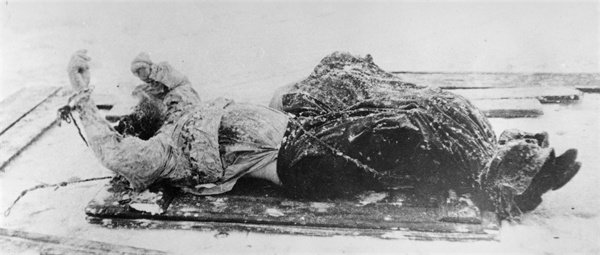
Rasputin.

Rasputin. Neva say die.

The Informant

The Informant (1935) is on, with Victor McLaglen in the title spot. One of the all time great big guy on celluloid performances. This is one doomed, dark, depressing, taut film. John Ford was about as far from Monument Valley as you can be. I love these flicks about The Troubles, I was raised hearing these stories and loathing the black and tans before I remember loathing anybody. The British machined gunned the people in the streets they told me. Grandpa put money in the hat at the bar. The queen can kiss my Irish arse, he said after a few too many. No one talked much about the IRA, too many bombings. But you knew where the sympathies were. I remember how he smirked when Mountbatten was blown sky high. Up the Republic, my grandfather would say, and sing the Rose o’ Tralee. His voice cracked where the melody soared. I still stop what I’m doing when I hear the song. I did tonight, early in The Informant, when the lad in the street sings it sweetly, almost spooky. The night is foggy and full of black and tans. They pat him down and he never misses a note. Black and Tans. I taste bile saying the words. When Wallace Ford takes down four of them before they he, Una O’Connor screams, but I cheered. Good boy I said. Up the rebels. Then I trailed off into more memories. Back East. Ribbons of green on St Patrick’s Day. Drunken little jigs and a little bit of heaven. There was no wearing the orange in Grandpa Nelligan’s house. He made me promise. I promised. I still don’t. If you swear it once, you swear it forever. A man is only as good as his word, he told me. I nodded childlike, sagely. Up the Republic he said. Up the Republic.

Victor McLaglen as Gypo Nolan.

Victor McLaglen as Gypo Nolan.