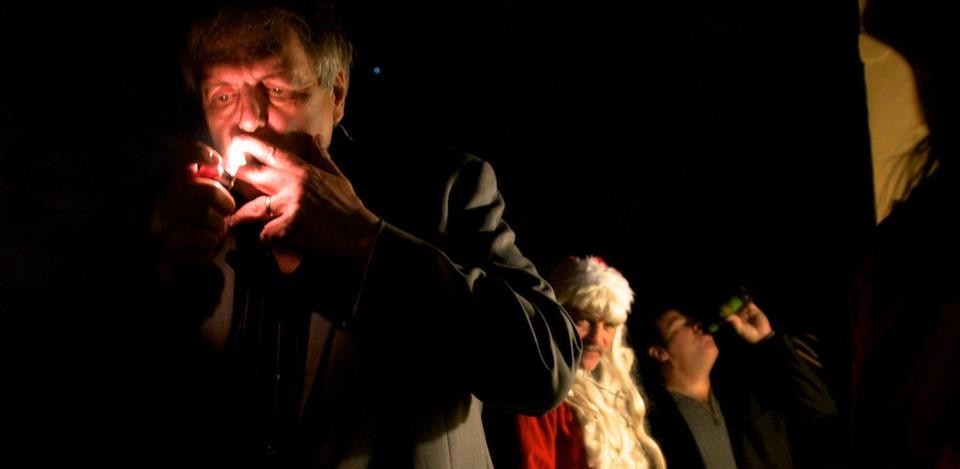
Mike Bloomfield

Pulling out LPs that I didn’t even know I had. Check out Mike Bloomfield here on Woody Herman’s Brand New (1971).

“Hitchhike on the Possum Trot Line”

Alan Broadbent is playing the groovy electric piano, it’s his tune. Frank Tiberi and Sal Nistico are back there on tenor. Woody is playing the soprano sax. Dig he and Bloomfield dueling it out past the 3:30 mark. You can hear Bloomfield at the top of his game on this record….it was all downhill from there. But then Herman had seen all that before, four brothers’ worth.

According to Ralph Gleason’s liner notes, Bloomfield was a huge fan of swing bands, especially Herman’s. Gleason suggested him to Woody who jumped at the chance. He was always filling the ranks with kids, and his band had a sixties rock’n’roll energy to it. Lots of rock covers, not all worked, but even those were noble failures. Herman confided that the band never got around to sending the charts to Bloomfield, who was freaking. Woody told him not to worry about it, it’s all the blues and to just come in and wail.

Which is how it happened. On the opening cut Bloomfield seems kinda nervous, but he opened up as he went along and by the end of his four tracks he was burning the place up. I don’t think he ever played with the band live, however, which is a drag. But then Bloomfield was a mess by then. I’m sure Woody Herman would have loved to do a whole tour with him. Woody Herman and the New Thundering Herd featuring Mike Bloomfield. Imagine the possibilities. It could have turned kids onto a great, hot band that didn’t sound like their dad’s record collection. And it might have revived Mike Bloomfield’s career. It hadn’t been too long since he’d played on Highway 61 Revisited, or helped Dylan outrage Pete Seeger at Newport. He’d blown minds with the Paul Butterfield Blues Band on East-West in 1966, played Monterey with the Electric Flag in 1967, went gold on Super Session in 1968. He was everywhere in 1969. Nowhere in 1970. By 1971 he was nearly forgotten. Hearing him here with Woody, though, each driving the other up in intensity, it’s hard to imagine that by then he was no longer one of America’s most influential guitarists. But he wasn’t. He was heading toward oblivion. Most people didn’t hear his name at all until ten years later when he was found dead in his car. He hadn’t died in his car. He’d died, rather inconveniently, at a party. So they put him in his car and drove him to another part of town and left him there. No note, no nothing. Police found him in the morning. It was in all the papers. Mike Bloomfield, I remember him.

When this album was released it got some airplay on jazz radio, as Woody Herman albums always did. Rock radio didn’t even know it existed. Oh well. Another of those what ifs that no one even knows was a what if.

MIke Bloomfield and Woody Herman

Mike Bloomfield and Woody Herman

Charlie Haden

Saw Charlie Haden at REDCAT tonight….his last show ever, I’m told. What a solo to go out on, Blue in Green, all that emotion, that beauty, not a note wasted, not a note that didn’t grab us, it was nearly overwhelming. We let the last thrum fade into the air before bursting into applause. It was an oddly restrained applause, an overcome applause, exhausted applause. Goodbye class, he said, smiling, laughing–he’d laughed all night, laughing and joking and being funny as hell–and was nearly overcome once, remembering Scott LeFaro (they’d been discussing  Blue in Green, Bill Evans had said it was his, LeFaro said it was so beautiful it didn’t matter) and he looked about to cry at the thought (after laughing that LeFaro wouldn’t let him date his kid sister)…then after that incredible take on Blue in Green he told the audience that Jim Hall was dead–they gasped–and he nearly fell apart. All this emotion, raw grief, bewilderment  at how such talent could just up and disappear like that….we of course were all wondering the same thing. But he caught himself, made another joke, laughed, dismissed us with a whisper–that’s all the polio has left him with, a whisper–and then he smiled. Just smiled. Some smiles you remember, some in fact you’ll never forget. Not ever.

Glad I was there.

Warne Marsh

A buddy of mine was smoking a jay with Warne Marsh outside Donte’s after the last set. Warne said hey man, you think you could spot me a joint for tomorrow’s gig? Sure man, love to. Turned him onto to a very nice bomber. Next night Warne died on stage, sax in hand, just like that. Warne was stoned, he was playing, he was gone. Poof. It was sad, but it was jazz. My pal explained it to me…ya see, I turned him onto his last high. Yeah man, I said, wow. My friend said well sure, you get it, but a lotta straights might think that’s fucked up, Warne Marsh being dead and everything…but I think it’s kinda cool. I mean he died with his boots on. He died stoned. He died blowing beautiful stoney solos. Damn man, what else could you want?  I said I did think it was kinda cool. Yeah, my friend said, that’s what Warne’s compadres were saying. They said dying flying blowing has gotta be the way to do it. Warne was no dummy. Wasn’t nobody’s fool. Makes sense to me, I said. My friend nodded, concentrating on the joint he was rolling. You have any Warne Marsh records? I pulled out one of the sessions with Lee Konitz, and Warne is weaving around Lee’s airy lines, and my pal takes a deep drag off that freshly rolled joint and closes his eyes and I think he’s back at Donte’s. He hands me the joint. I declined. I gotta drive, I said. So I remained in the now listening to a record, while he slipped into a Warne Marsh space. He held up the joint. This is some good shit man, tightly rolled, slow and steady burning. He sounded like an old Lucky Strike commercial, though I didn’t know if he meant the weed or Warne. Or both. I took a deep breath and got a second hand taste. Wow. I closed my eyes and there was Warne. Just like that. Magic. A marijuana time machine. The vinyl spun and the analog music was right there, like real. Those grooves grooved, man. Warne takes off. I could almost see the golden bell of his horn. My friend’s pot smoke weaved around my head. I leaned back and listened.

It’s years later now and I’m digging Apogee as I type this, and if I had a jay right now I’d be at this session too, watching and listening. I don’t. But Pete Christlieb and Warne Marsh are dancing around each other on Magna-Tism, the student giving the teacher a run for his money. Damn.

Lee Konitz blowing, Warne Marsh waiting, Al Levitt on traps. Somewhere in Holland c. 1976.

Coleman Hawkins playing “Picasso”.

Coleman Hawkins–“Picasso”

One of my favorite jazz pieces, it seems forgotten today. Not sure why. He recorded it in 1948, well before people really thought of doing anything like this. It’s an art piece, really, and within twenty years there’d be hundreds of solo tenor sax recordings. But in 1948 this was about it. I suppose with the bebop explosion going on something as spooky and contemplative as this would be passed over. It’s not as exciting as “KoKo”, certainly, or “Salt Peanuts”. But it’s deep, and it’s beautiful, and it’ll hang with you for quite a while. Those were jukebox nights then, and for a nickel you could sit at the bar and smoke and drink and listen to the notes of an unseen saxophonist. It ends with the melody hanging in the air, unresolved, just like this.

.

Coleman Hawkins

Gerald Wilson, coming from a different time

(2013, after a show at Catalina Bar and Grill, Hollywood)

Staring at sound. I saw Gerald Wilson do just that a couple nights ago, staring right into the bell of a screaming tenor sax. Kamasi Washington was blowing like a freaking hurricane, just roaring, and Gerald stood maybe two feet in front of him, letting that crazy dangerous torrent of notes wash right over him. He watched and counted time almost invisibly, nodding ever so slightly for another chorus, and another, and another. Kamasi was loud, a big huge room filling sound, and Gerald, 95 years old, never flinched. I was sitting a few feet away, with a profile view of the scene and wishing so bad just then that I was a photographer and not a writer because I could see the picture, still can, and if I had taken that picture I’d stick it right here and cut out a thousand words. But all I have is that image burned into my brain, as perfect a jazz image as I’ve ever seen. And one I’m not likely to see again, not so close, not so perfectly framed. Gerald comes from a different time.

Gerald Wilson in the throes of creation in this priceless shot by Tony Gieske.

Gerald Wilson in the throes of creation…. (photo by Tony Gieske from the International Review of Music)

St. Louis Blues

Play this one loud. Hooch helps. So does mezz and the warm night air. About 6:54 Trummy Young destroys the world, though Louis puts it back together again about 7:42. Repeat.

St. Louis Blues: https://www.youtube.com/watch?v=uPEVmBOfiC8

Louis Armstrong Plays W.C. Handy (1954)

Louis Armstrong Plays W.C. Handy (1954)

Elvin Jones

Incredibly great photo of Elvin Jones. The photographer had quite an eye, and would have crouched low on the stage looking up and waiting for the exact moment when Elvin’s face appeared between tom and cymbal. This is instantly one of my favorite jazz photographs ever (is it off an LP jacket, have I seen it before?), and thanks to drummer Fritz Wise for passing it along.

I’ve always thought the best jazz shots–hell, the bet shots of any music–came when the photographer got in groove with the players, and for a moment it’s like the photographer is one with the band, snapping pictures in perfect time.

Elvin Jones. No idea who took the shot, but thanks to drummer Fritz Wise for posting it.

The great Elvin Jones, though that flat monosyllabic great doesn’t quite do the man justice. You need polysyllables in polyrhythmic meter to describe Elvin Jones, but that’s poetry, and this is a caption.  No idea who took the shot, if anyone knows please pass it along so I can credit.

Lester Young

My pal Vince Meghrouni–a fine saxman himself–posted this picture of Lester Young. Vince loves Lester Young. Loves Dexter Gordon more, probably, but he loves Lester Young. It’s a haunting photograph, he’s so thin, so gaunt, really, playing for nobody but the photographer in a bare room. Just the bed, a phone, a clarinet, and a saxophonist. I asked Vince if he knew the when and where of the thing. He said sorry, he didn’t. Just one of the things plucked from Google. He just dug that it was Prez. Others liked that it was Prez too. Prez! they said. The President! Imagine that….you’ve been dead for more than half a century and people see your picture and say, simply, Prez! A nickname of a nickname transcending generations.

But it’s such a sad, haunting shot: Beautiful and sad. It looked to me to be near the end.

Lester Young--Jazz City

I dug around the web for a while, looking for answers. Turns out the photo is by Dennis Stock from a single volume collection entitled Jazz Street. You can find it but it’ll cost you, it’s a rare one. Stock was one of those post-war photographers, that New York City feel, film noir, far too early in the morning. It seemed a harder time then, at least in the cities, far from the suburbs, and photography bore that out, black and whites of blacks and whites wreathed in smoke, thinking, listening, worrying, angry. Mr. Stock shot all these jazz pics in the late 50’s, from 1957 onward. Prez died in ’59, and looked decidedly less frail in the Sound of Jazz in 1957 (playing that perfect solo for Billie Holiday) than he does here, so this is probably closer to the end, maybe 1959. He was suffering from cirrhosis (as you can plainly tell here). I heard that he lived in a flat across from one of the jazz clubs (the Vanguard?) and rarely emerged, essentially drinking himself to death. His last few official recordings from this time sound a little frail, but they still swing. I’ve got a couple live things, board recordings I think, that sound sloppy drunk, though I like them anyway.  He did a couple gigs here and there those last couple years, but wasn’t getting out of his room much.  Drink, illness, maybe mental illness, maybe all three. He made a last stand in Paris for a couple weeks in late ’59, nearly drinking himself to death in the process and probably breaking a lot of jazz lover’s hearts with that sound still coming out of that body. Dexter Gordon seems to nail that as Dale Turner in Round Midnight. Lester Young returned to NYC and did finally drink himself to death a couple days later. He was forty nine years old. They buried him somewhere in Brooklyn. It must have been one helluva funeral. Everybody would have been there, telling stories, remembering better times. Mingus wrote “Goodbye Pork Pie Hat” soon afterward. A ridiculous hat, a beautiful tune. You can’t see the hat in this picture. You can’t hear the saxophone, either, but you can imagine it. You look, and if you know Lester Young’s music, your mind fills in the sound for you. It fills that whole room, a thin little man, a bed, bare walls and all that saxophone. A black and white photo and the lightest, most gorgeous tone you’ve ever heard. Perfection.

“Fine and Mellow” from The Sound of Jazz, 1957.

(Lester Young takes his solo about two minutes in. Within two years, both he and Billie Holiday were gone.)

Jack Sperling

Jack Sperling was on I think all of Pete Fountain’s great records in the 50’s and 60’s and really pushes that quartet. A real driver. I don’t even know f they have drummers like him anymore, not the way he swings. The snare used to the thing then, the engine. Kenny Clarke changed all that I suppose. It’s kind of a shame…I’d love to hear somebody play a snare like Jack Sperling did, like it was the heartbeat of a jazz band, and if it stopped the music stopped.

You know I’d just love to go to a jazz joint and hear a good Muskrat Ramble. I mean solid, by some killer players. But you can’t drive a Muskrat Ramble with the ride, can’t accent it with rimshots and certainly can’t drop those bombs. Nope, it’s all square on the snare, hard, impeccably timed. No drummer worth his charts plays that way today. It’s light years beyond what it was. Be bop changed the drummer’s universe completely.  Drummers before be bop and drummers after are like different species. Their musical DNA totally unrelated. I go out now and I’ll hear amazing stuff, mindblowing stuff. Stuff so new it sounds utterly wrong, and I have to stop watching and listen with my eyes closed before I can see what it is. Drumming just keeps expanding and expanding, big banged  far beyond Baby Dodds and Chinese cymbals when jazz was born. I remember once listening to a Miles Davis album and hearing nothing but Tony Williams on the ride. It wasn’t even loud, and Miles and Ron Carter and Herbie Hancock were doing amazing things, but all I could hear was that ride. It just sucked me in. It drove the whole tune. I didn’t even hear the snare, didn’t need to. It was about that ride cymbal. I don’t know if even Big Sid Catlett who, once swung a whole band with nothing but brushes on a phone book, would understand that. Joe Jones would probably have punched me out.

So I’ll never hear a Now’s the Time or Lonely Woman or Naima or even Take Five with its heavy Joe Morello drum break followed by a Muskrat Ramble. Not without an old school drummer. A Paul Barbarin, say, or a Zutty Singleton. A Cozy Cole or Ray McKinley or a Big Sid Cattlett. When they died they took a whole music with them. You could find the horn players now, and the reed players, a banjo player, even a tuba for a bass, but you’d be stuck looking for a drummer.  You’d look and look but the beat would be all over the kit, off the rims, dropping onto the bass pedal. It would disappear from the skins completely and reappear on the ride cymbal, incessant and hushed. Sometimes it would disappear completely into syncopated space. It might be the most amazing drumming you ever heard on an ancient New Orleans jazz tune. But it wouldn’t drive the thing. It wouldn’t give it the insistent pulse that was at the core of that old jazz music. There’d be a big hole where that beat was supposed to be. You could have the hottest trumpets and swingingest clarinets in a perfect New Orleans cacophony, but you’ll never find a Jack Sperling again.

A Jack Sperling album I'd love to hear.

A Jack Sperling album I’d love to hear.

Quincy Jones

I was beckoned once to Quincy Jones’ table–his bodyguard chased me down in the parking lot with a Mr. Wahl, Mr. Jones will see you now–on some bit of jazz journalism business that turned into he and Freda Payne and me and my wife Fyl drinking wine and talking till way past Vibrato’s closing time. All was dark save the light above his table, Quincy laughing and pouring and regaling and asking my wife about punk rock and telling us at length, of all things, about New Order and what a smash they were. The talk was of whatever the wine loosened up or I thought to ask, I can’t recall, just late night free association, an infinitesimal bit of the total Quincy Jones experience.  Meanwhile, in the shadows, the help stood patiently waiting for Freda to say maybe it was time we all went home. We did. It had been just another night out for Quincy Jones, one of thousands, and a favorite ever jazz journalism memory for me. It wasn’t the first time we’d met–he once plunked down in the seat next to mine at a press event and turned to me to fill in his memory every time something slipped his, which immediately rendered my own a complete blank, and I slunk down in my seat wondering why couldn’t he have sat way over there–but that night at Vibrato was something special, precious even, the kind of story you can tell till the end of your days, till it becomes part of your own mythology and people will tell, at your wake, that he once got drunk with Quincy Jones.