Don Preston

Had a nice long chat with Don Preston yesterday. I was at Rockaway Records selling some cds and he was there waiting for his overheated car to cool down. He asked the clerk if they had any Mothers of Invention memorabilia. The guy said they do sometimes. Don said thanks. Don’t think the clerk knew he was talking to one of the actual Mothers. Somehow George Herms came up, and Bobby Bradford and Chuck Manning and Elliott Caine. Mutual friends. Odd gigs, holes in the wall, recording plans. On the way out I gave Don a lift to his car a block away. Met his wife.

Way before L.A. and Paul Bley and Frank Zappa, Don used to play with all the Detroit cats, Elvin Jones and Tommy Flanagan and Yusef Lateef. He’s from Flint, though. I should have asked him about that. My pop’s family was from Flint. I had a piano playing uncle Carl who was quite the prodigy. There’s a recording of him somewhere going mad on Gershwin. Alas, he got his start playing speakeasys and it did him in, eventually. But there’s a possibility that my sodden thirty something uncle and a teenaged Don were in the same place somewhere in Detroit in the late forties. Somewhere people were playing jazz on a piano. One of those meaningless little might have beens that hang in the air for a second or two, then disappear.

Lawrence Welk

Wow. Lawrence Welk.

I’ve never been able to watch The Lawrence Welk Show long enough to see if that’s Eddie Miller blowing sax. But this was one of Lester Young’s favorite shows. Yes it was. He loved Perry Como too. A friend of mine lived next door to him. Every time he dropped by Prez’s pad, he was listening to a damn Perry Como 78. Listening to it over and over. Obsessed with it. Said he was trying to learn it. My friend couldn’t hear what Prez was hearing and went back upstairs and listened to bebop. I wish I knew what Perry Como song it was that Lester Young was listening to over and over. No doubt it slipped into one of those airy, lazy solos of his, perfect and gorgeous and so square but you’d never know it. Lester Young, a bottle of gin, a saxophone and this, The Lawrence Welk Show. Geniuses can be so strange.

Uh oh, the tap dancer.

One of those records nobody talks about.

One of those records nobody talks about.

Gerald Wilson

[from Brick’s Picks in consecutive issues of the LA Weekly, 2011]

The Gerald Wilson Orchestra are perhaps this town’s signature big band. Gerald Wilson has that direct connection with this town glory days, when jazz ruled up and down Central Avenue and L.A.was second to only New York City in the quality and quantity of jazz. Of course, that was a helluva long time ago. But Gerald Wilson was there. Way back in the thirties, playing trumpet and writing arrangements for the great Jimmy Lunceford band. But here’s the thing…..Gerald Wilson never stayed back there. He left that era behind. He may have lived that history, but he’s not stuck in it. He kept writing and playing all along, putting out incredibly hip stuff in the sixties, the seventies, right into this new century. He’s had a vital, muscular orchestra all these decades, cycling in new blood and keeping on the veterans who still have the fire. The material is thrilling (including, of course, “Viva Tirado”), the solos are exultant, and the band always plays like their lives depend on it. Wilson, all ninety plus years of him, is up front driving them. The players feed off his energy and he feeds off their power. The audience gets swept up in all this jazz celebration. You see the Gerald Wilson Orchestra and you feel lucky to be there, like you’re in on a very rare thing. You are. On a good night (and we’ve yet to see a bad night) they just might be the greatest big band in the world. They’re at Catalina’s on Sunday at 7:30. One set only. Be there, man. Just be there. Continue reading

Chuck Niles

(my first piece for the LA Weekly, 2005)

Longtime KKGO-KLON-KKJZ disc jockey Chuck Niles has passed away, having worked up until quite near the end. In a medium full of empty-headed blowhards and Clear Channel Stepford-jocks, Niles was in every sense an “on-air personality.”

I met Niles a couple of times — it was easy enough. He was a denizen of the local jazz clubs; pop into Charlie O’s on a weeknight, and there was a good chance he’d be there. Last time I spoke with him, I was standing at the bar, and there was that voice: the unmistakable Chuck Niles whiskey baritone. He spun a few stories. Though he didn’t know me at all, as with all great radio personalities you’d swear he was your friend — you’ve spent so many hundreds of hours listening to him. He came off as just a neighborly cat who happened to be the greatest jazz disc jockey in the world.

Niles was quite a supporter of living jazz, plugging local players on his show. And in the clubs, you’d see him approach some young piano player between sets and compliment him on his swing, and the kid could barely keep his imperturbable jazz expression, he was so thrilled. Because Niles had been there; he had that bemused sense that I believe comes from having lived near the beginnings of a cultural revolution — bebop. Niles knew many if not most of the founding boppers; he saw them play, bought their earliest 78s. A lot of stories slipped away when Chuck Niles passed on. We’ll still hear some of those stories, of course, but now they’ll seem like just history instead of experience.

I’m spinning the bop and the straight-ahead for myself now, just wishing that some folks could live forever.

Miles Davis, once removed

One time I was asked to attend an event–one of those Miles Davis events, some album cover art thing again–and when I got there I was literally the only person from the jazz world present. No critics, no players, no fans that I could tell. A lot of arty types, and some very beautiful women, and dudes in slick suits and bling. There was no food and the scenesters started splitting. I looked at all the paintings (alas, I’m an art ignoramus) and was about to leave when the publicist grabbed me and said she wanted me to meet Miles’ daughter. I was introduced. Miles’ daughter looked bored and tired and sick to death of hangers on and sycophants and especially critics. She rolled her eyes, sighed, and turned away without saying a word. The publicist blanched but I remember thinking how cool…I was just totally dissed by Miles Davis’ daughter. It was too perfect. It was almost like having a Miles Davis experience. Jazz was once full of Miles Davis experiences. His raspy voice, his sighs, his sting. Jazz musicians tell and retell those stories their whole lives. Critics still wince remembering their own painful encounters. Alas, I’d come along too late for that. But this was the next best thing. A story I’d be telling for years. His son, though, was a real disappointment, friendly, polite, affable and apparently pleased to meet me. A nice guy. We talked a while, and I wondered if he was adopted. OK, I didn’t. That’s ridiculous. But what a contrast. Anyway, the event was pretty dull, but Miles Davis’ daughter made my night. I met her again later, at some other function, and she was perfectly sweet. But I had lucked out that first time and caught her on a bad night. When you’re a critic with lots of readers you get a lot of fawning attention, it’s unavoidable. It used to drive me nuts, every one being so nice to me. Secretly I couldn’t stand it. So getting the full Miles from someone who was part Miles…that was priceless. One of my favorite jazz memories, in fact. I had my own Miles Davis experience, once removed.

Charles Owens at the World Stage

(from an LA Weekly article–2005. My editor Greg Burk and I went down to Leimert Park and wandered about. Talked to a bunch of the local jazzers. He wrote it all up in a piece and then added part of this account of a gig at the World Stage. Space limitations let him use only about half of it, but here it is in all its raging glory.  To this day, I look on this Charles Owens performance–if that’s the word, it seemed more than that–as one of the most spectacular nights of saxophonery I’ve ever witnessed.)

Went down to Leimert Park on Saturday night to check out sax player Charles Owens and trumpeter Richard Grant at the World Stage. Inside, the place is just a tiny storefront with folding chairs, really, and it was stifling. Nedra Wheeler was squeezing her double bass behind an unused drum kit. Derf Reklaw, up front by his three congas, was tearing the folks up with an outrageous story about some nearby African gig where he was yelled at by the bandleader for not dressing African enough. “What you mean, man? These clothes are from Senegal! I bought ‘em there!” Owens walked in decked out in matching powder-green shirt and slacks and a big white Stetson. Absolutely incongruous; someone cracked wise about the hat. A guitar player, whom I did not know (it was a very young Steve Cotter) took one edge of the stage as Owens busied himself taking away that unused house kit a piece at a time, giving the band some breathing room. A local loony took a seat in back, chortling a little too intensely, and the doorman hushed her — for the first of several times. Outside on the street, a trumpeter was blowing loud, flat, cracked notes. Someone went out and shushed him too. Owens was doing mostly Joe Henderson tunes. Reklaw laid out some Elvin Jones rhythms that kicked up the energy — certainly got the loony going; she was squirming in her seat and shouting like Moms Mabley on bad acid. In the second set, Owens’ “Shake Your Booty” was genuinely funky; he took his solo from the back of the room, and the whole place seemed filled with the music; the loon was going even more nuts. Owens took his solo outside—literally, out onto the sidewalk, playing for all the folks out there–came back in, dropped out and Wheeler took over, laying down a swimmy groove. The encore on Joe Henderson’s “Jinrikisha” was the best, Grant blowing like Freddie Hubbard, Owens filling the air with flurries and screams, Wheeler and Reklaw locked in a monster groove, the guitar player darting around all of them. After most of the folks had wandered out, it still wasn’t over. Don Littleton came up, started messing around on the congas, Reklaw picked up his bongos, and suddenly there was a new jam, with Owens playing “Cherokee” at bop tempo over the manic hand drumming, crazier and crazier till, just like that, it ended. Reklaw, shaking has stinging hands, sat down. Littleton started up again, and Owens jumped in even madder, freer than before. When it stopped, the dozen people remaining burst into applause. They’d seen the most dangerous jazz created anywhere in L.A.that night.
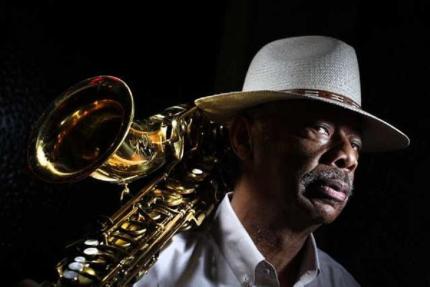
Charles Owens

Charles Owens

(Photo is by Rick Loomis from Greg Burk’s fine piece “Charles Owens, spreading the jazz faith worldwide” in the Los Angeles Times Sept. 17, 2011. Make sure to follow the link to the full profile.)
Long, low tones

(Brick’s Picks, LA Weekly)

Years ago we heard Chuck Manning and Sal Marquez duet into the wee hours at a party in the hills above Pasadena. The home was old and Spanish, the lights of the city spread out in all directions, and Manning blew long, low tones that Marquez softly cavorted in and around…. Just one of those boozy late night jazz memories.

Photo by Tony Gieske.

Piano

(Brick’s Picks, LA Weekly—first draft, 2011)

I was at the Autry Museum a few years back and in the middle of the lobby some cat was making a dug out canoe. He had this enormous chunk of tree right there in the middle of the floor and he’d been hacking away at it in the traditional style. You could see the shape emerging at the one end. The other end, though, was still a big old chunk of tree. I looked at the thing and for some reason tried to figure out how to describe the thing in words. And I froze. It defied my descriptive abilities. This big giant half dead tree half boat thing all carved up, shavings everywhere. I stared and stared but damn man, it rendered me mute, language wise. I kept going back to it seeing if anything emerged, a sentence or three, anything. Nothing. On the way out of the place I made a long detour so as not to look at it again. It still haunts me, years later. It haunts me every time we have to write about a piano. Continue reading

Forgetting

I was at an event a couple nights ago when it was announced that Jim Hall has died. People gasped audibly. The lady next to me began to cry. That’s when I knew for sure it wasn’t a hardcore jazz crowd. Jazzers just sigh and move on. There’ll be a nice memorial, a lot of the departed player’s music on the radio for a few days. Then on to the living. Jazz musicians have been dying since the 1930’s. That’s when the first generation began to go in large numbers. (Life spans were shorter then, and they began to go in their fifties.) After a few generations all that death becomes part of the music’s natural cycle. Sad, inevitable. Rock’n’roll fans will be there in a generation themselves. But rock fans now are in for an endless wave of the sixties greats dropping off, and it’ll be hard, and they’ll cry. Maybe because rock is a music of youthful days, and old age seems somehow cruel and ironic. I don’t know. But I do know that the social media is awash in mourning when a rock hero dies, almost to the point of tedium, whereas jazz fans let it go after a day or two. Two different ways of looking at the same thing. It’s just that jazz people are so used to it.

A buddy of mine, a jazz historian of long standing, told me once how he’s watched entire generations of jazz–entire styles–disappear. He used to interview the 1920’s classic jazz people but then they were gone. He’d interview the swing era people of the 1930’s…but they disappeared. The be boppers of the forties are nearly all gone now, he said. Next comes the great Blue Note era, maybe jazz’s greatest period. So many heroes. So many obituaries. Barely a week goes by now without one. Jazz fans sigh. Continue reading

Mitch Mitchell

(Found this posted on both Just Another Blog From L.A. and MetalJazz.com. Both are great blogs, btw. I assume I’d written it as an email. 2008)

RIP Mitch Mitchell. Jimi Hendrix’s drummer. The dude wailed like nobody. Tiny little English bastard doing his best Elvin Jones. Cool. And man could he get up a shambolic shuffle. Listen to “Hey Baby”…the one from “Rainbow Bridge”. Hip hippie jazzness at it’s best. Wasn’t another rock drummer that could play just like that. Dropping in Max Roach snare snaps and rim smacks and riffling popping toms, some heavy tom shit like Joe Morello in “Take Five” (remember that one? Mitchell apparently dug Morello’s thunder rolls) and all that Elvin that Jimi wanted–like when they come out at Monterey and light into “Killing Floor” and Mitch’s rolls are so all over and so in there (or close enough) and man, it’s frigging glorious. Crazy crazy rock’n’roll, man. Just like god intended it to be, if god smoked a lot of dope and didn’t worry too much about meter….

Did he and Keith Moon ever play together? Can you imagine?

Nice guy, too. It was a dinner party somewhere in Silver Lake, eons ago. All these miserable guitar players wanted to play “Red House” with him, like he hadn’t been there and done that like sooooooooooooooo much better…. Incredibly, he smiled and put up with them all. They raise ’em polite over there in England, apparently. When at last freed from his throne there was a dinner party inside. Someone put on Mingus. Two, three notes into it and Mitchell flipped. I love this!!! Who put this on!!!!!! Outside some guitar players were brutalizing Red House, and inside Mitch Mitchell is hovering over the phonograph, hearing nothing but Mingus. Yeah, alright. They can’t live forever.

Mitch Mitchell wailing on the snare.