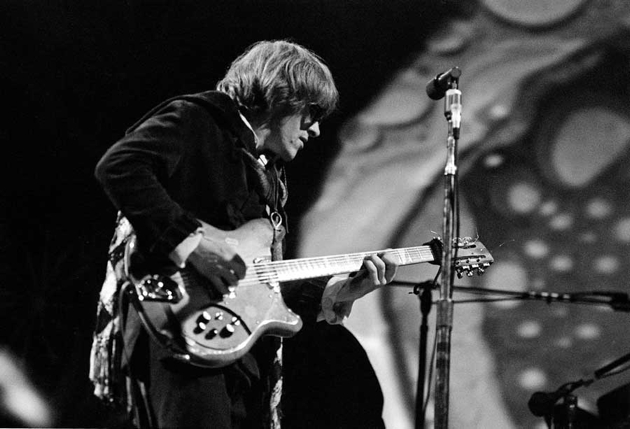
Paul Kantner

(from an email to Greg Burk)

Yeah, After Bathing at Baxter’s has wound up my favorite rock album, at the top of the pile for years, as others have come and gone. In fact, only the Sex Pistols rate with the Airplane in being a transformative band in my adult life. I heard the Pistols when I was twenty, in ’77, and it was ’77 that I picked up Baxter’s, the oddly obscure (by then) Airplane album, the one you never heard on the radio. I had most of the others. Baxter’s blew my mind like Captain Beefheart’s Trout Mask Replica blew my mind, it was overwhelming, a mind fuck. Somehow it overtook Trout Mask in importance–helped along no doubt by Spencer Dryden‘s drumming–and I still listen to it with varying degrees of awe, depending on how stoned I am. I listen to it dozens of time annually, always have. It’s the only record I have that I listened to dozens of times annually since I bought it in some hippie used record store in Isla Vista. And over all these decades of being a rock fan, the only two essential–as in needing them to breathe essential–rock albums left for me are After Bathing at Baxter’s and Never Mind the Bullocks, bought both that same year, 1977, when I was twenty years old. And when I heard Paul Kantner died, my favorite Airplane, the genius of the bunch, with his amazing sense of harmony and rhythm, I felt the briefest twinge and got on with life, which is the way it should be, because otherwise you don’t get it, you don’t get it at all. Paul got down, not the first time, you know. Paul got down and got up to go. And he’s gone.

paul-kantner-monterey

Monterey Pop Festival, 1967

Peaceful Easy Feeling

And I found out a long time ago/What a woman can do to your soul/Oh, but she can’t take you anyway/You don’t already know how to go….

Oh god, not Peaceful Easy Feeling. I hate this song. I mean listen to the guy, Glenn Frey or whoever, whining about what a woman can do to your soul. Oh please. He’s a rock star. The only women trouble he had was picking one. They were probably lined up from the back door of the Troubadour half a block down Santa Monica Boulevard, all looking like Joni Mitchell. And what the hell does “you don’t already know how to go” mean? It must mean something, or else they would have picked a line that wasn’t so forced rhythmically. That “already” drives me nuts. Gives the line one syllable too many. You have to sing “already” really fast to squeeze it in. Obviously, something as clumsy as “you don’t already know how to go” means something. But what I have no idea. I know, I know, maybe I should stop wasting time worrying about song lyrics. I mean it took me several years of stoned exegesis before I figured out what the hell Neil Young meant with “I been standin’ on the sound/Of some open-hearted people/goin’ down.” And I like Neil Young. Well, maybe not Heart of Gold, but Roll Another Number For the Road, I can dig it. Well used to dig it. Nowadays you roll me another number for the road and I’d never even make it out of the driveway. I’d be in the trunk communing with the spare tire. Weed’s gotten stronger and I’ve gotten older. I got a second hand buzz just watching The Harder They Come the other night. Then I got the second hand munchies and switched to the Food Channel. So maybe worrying over a line in Peaceful Easy Feeling, a song I’d rather never ever hear again, is ridiculous. Maybe it seems obsessive. But then I have real problems with the Eagles. I lived through that era. I remember being a teenager with an AM only radio in my car. I remember how Lyin’ Eyes was an hour and a half long and they played it every ten minutes. And I know that sounds impossible, but it was the seventies.

Desert Island

So someone asked me what ten albums I would take on a desert island with me. I asked if there would be electricity. She said yes. A desert island with electricity? This is more Bob Denver than Tom Hanks, then? Just shut up and write the ten records. Jazz records? Well, if you must, then jazz records. I couldn’t come up with just ten jazz records, I said, I don’t do lists well. Then ten rock records. There must be ten rock records you like. Like enough to take to a desert island? Yes, like if you were going to be marooned on a desert island what ten records would you take with you? Marooned? Would there be native girls? Giant stone heads? Don Ho? Apparently I was no longer funny. I started on the list, came up with four records and got stuck. Not sure why those four. I gave her the list. Where are the other six? I could only think of four, I said. You’d take only four records? I travel light, I said, and someone will have an iPad. No answer. You said there’s electricity. Still no answer. I can think of six songs, I said. I rattled them off. She’d never heard of them. Not even Home is Where the Floor Is. But that’s one of my favorite songs ever, I said. It was HUGE. It wasn’t actually, of course, just in my head. What album is it on, she said. Some comp. I sold it. Then you couldn’t take it with you onto the desert island. You mean I have to actually own the record? There won’t be an iPad? Nevermind, she said. And somewhere, there’s a blog without my list of four records.

Five records. I just thought of another. Tables and chairs and TV and books and other stuff.

Jazz album covers

Just saw a photo of a bunch of jazz musicians–some of the very best in fact–making silly faces. I was taken aback. I mean is the serious jazz picture phase is over? Did someone kill it? I don’t have a jazz column anymore and don’t keep up with these things. I can never keep track. There have been so many phases. I have records from the fifties with these old time musicians grinning like happy drunks. Which they probably were, bombed. A little reefer. Meanwhile the bop guys are all serious, way serious. Suits too. Matching. A little too big but matching. None of them ever cracked a smile. Too many changes. Wild tempos. Pawned horns. Suits were out by the angry album cover era. Dashikis, even on white guys. With their dashikis, long hair, and horn rimmed glasses, the white guys always looked like engineers on acid. The black guys looked angry. Man, were they angry. Scary angry. I once looked at a Pharaoh Sanders album and hid under the bed for three days. I was never comfortable with the 80’s happy jazz picture phase. Sonny Rollins happy was weird. Chick Corea disturbing. I’d listen to the albums but try not to look at the covers. My favorite period was the jazz musicians in bell bottoms and sideburns and leisure suit era. You’d see them on their album covers trying to look like hippies but always looking like heroin dealers. Then there was the everyone dressing like Sly Stone period. Huge hair. Huger flairs. Heels so high they created their own weather patterns. And bling baby, bling that made Isaac Hayes blanche. Sometimes, though, the players looked less like Sly Stone and more like Elton John crossed with an electric chicken. Which wasn’t actually the intended effect. But I digress.

A lot of those albums sure were great, though.

Herbie Mann saving money on clothes.

Herbie Mann saving money on clothes.

Artie Shaw again

Found an old flick on some station, Second Chorus, Fred Astaire and Burgess Meredith cracking wise, Paulette Goddard her usual little knock out self, and I’m not paying attention till I hear a clarinet and it’s Artie Shaw and band, doing Everything is Jumpin’. Such a sound he had, that Artie Shaw. Great stuff. Johnny Guarnieri on piano I recognized, and Nick Fatool on drums. Great Billy Butterfield trumpet solo. It was 1940. Europe going all to hell, Artie at his peak. Selling tens of millions of records, playing big halls, broadcasts, movie appearances, raking in the cash. Married to Lana Turner even. He’d be ducking Japanese bombs in a couple years, and then the Big Band scene imploded after the war. A slew of other wives. But 1940 was the pinnacle, and Artie was already bored. You couldn’t hear it in his playing, though. And he never stopped making great music until he packed it all in for good in 1954 and lived forever, almost.

Artie Shaw with Nick Fatool in Second Chorus. Not much of a movie but everything is jumping in this scene.

Artie Shaw with Nick Fatool in Second Chorus. Not much of a movie, really, but everything was jumping in this scene.


.


Creativity happens only once

A couple decades ago my pal John Altman was doing a session with jazz violinist Stéphane Grappelli. The producer in the booth asked Grappelli to play like he did with Django Reinhardt back in 1936. There must have been an uncomfortable few seconds, perhaps a sigh. “I wouldn’t know how” Grappelli said.

People sometimes ask me to recite passages from something I wrote as if I had it all memorized. This doesn’t happen as much now but when I was writing my jazz column it was a regular occurrence, sometimes two or three times a night. What was that you said about this gig? I almost never had a clue what I’d said about the gig. No idea. Why would I? I’d already written it. It was gone. Tucked into some corner of the memory, probably, filed away, and in all likelihood never to be seen again. I can’t even recognize my own writing lots of times. People have quoted me to me without me knowing it. I ask who wrote that and they stare at me. You did. I apologize. They’d give me a look, like I must be some kind of jazz critic idiot savant. Once I laughed aloud and said what fool wrote that? It was me. I don’t ask that now. But I still find it weird that people assume I can just recite anything I wrote. Because that’s not how it works. You’re writing in the moment. And once done, you put that writing away and think about what you’ll write next. There’s nothing in the creative process that enables you to go back and recite by rote anything you’ve written. Indeed, of the million or so words I’ve written in the last twenty or so years, I can recite but one line: “Broken back mountains, a lizard, a snake, and the meaningless rippling of sand”. And I remember that only because it pops into my head every time we drive that desiccated little stretch of Highway 111 on the way into Palm Springs. That is it, the only line I’ve ever written that I can repeat from memory.

I can’t see how improvising a jazz solo would be any different. It’s purely of the moment. You’ll never create the same solo again. You might re-create it, if you listen to a recording and figure out exactly what it was you did, but next time you’re playing that piece and its your turn, that same solo will not emerge from the bell of your horn. It’s the same with words. The second draft is always a new creation. Jazz soloing is pure creativity. Not painting by the numbers. When the band leader points at you you’re on your own. And when you’re staring at an empty screen, fingers poised, that opening sentence comes to you and you roll with it. You have to. It’ll never come to you again. Not like that. Creativity happens only once.

Stephane Grappelli and Django mid-creation, 1935

Stéphane Grappelli and Django Reinhardt mid-creation, 1935.

.

Jack Bruce

So Jack Bruce died. A whole age group of music fans felt a pang reading that for the first time. He was part of our young hipness process. One of those serious jazz loving bass players you’d find in rock bands back then, like they lowered themselves a notch to play loud blues and love songs. Which wasn’t true, really, but that was the thinking. Jack Bruce was the quintessential one of those. Kids would mention their favorite bass players and you could say Jack Bruce and be hipper than all of them. Ginger Baker too, though that didn’t last for me. He was just a pounder. Make him an astronaut. But Jack did stay with me. I remember watching that Cream reunion a few years ago on a hundred television sets in Circuit City, and aside from Eric Clapton’s solos, which were good, even fired up, the band was limp and weak and not the Cream I remembered from all my albums. Jack on a fretless bass didn’t help any. He couldn’t dumb it down just a little to slam through a Sunshine of Your Love or Tales of Brave Ulysses even though he managed the yelp in precious ears WERE tortured. But Deserted Cities of the Heart took on something new with his jazzier playing, and We’re Going Wrong (a favorite of mine off Disraeli Gears I’d forgotten all about) was gorgeous and spooky and perfect for him. His bass carried it. It was a couple levels above all the Cream classics, it seemed to me now, like a different band altogether. It knocked me out. I think Crossroads followed. His bass line had carried that one, too, on Wheels of Fire, Clapton soaring overhead, Jack keeping it together. Not at Royal Albert Hall, though, not in 2005. They’d rocked the place on their last show there back in 1969 (you can see for yourself in Farewell to the Cream, a standard in the hippie art house theaters back in the day). But not this time. Jack’s heart wasn’t in it. This Cream thing wasn’t what Jack Bruce was three decades on. He was beyond all this. I watched a hundred televisions thinking all those cheering people were seeing what I was seeing but they were hearing Disraeli Gears. That wasn’t the real Jack Bruce up there, the Jack Bruce who’d been growing in stops and starts ever since Cream said farewell. He was never a superstar again, but he was a musician, and kept doing interesting things, despite bouts of melancholy. Alas, I never saw him play, not even once. I intended to some day, but never will now. I no longer have any Jack Bruce records, either, and haven’t even heard his Tony Williams Lifetime project Spectrum Road from 2012. Or his very last, Silver Rails, from earlier this year. Everyone told me how good that one was. And you have to see him live, they said, he’s a legend, he’s Jack Bruce. I said I would, one of these days. Oh well. Sometimes you miss things, and then it’s too late. And my Cream albums are long gone, all of them. Even Live Cream Volume II, with its incredible take on Deserted Cities of the Heart, which would seem appropriate right now.

Jack Bruce's final release, Silver Rails. The extraordinary painting is Sacha Jafri's "The Child Within - The New Adventure".  Few musicians have the confidence to share an album cover with something so extraordinary.

Jack Bruce’s final release, Silver Rails. The extraordinary painting is Sacha Jafri’s “The Child Within – The New Adventure”. Few musicians have the confidence or humility (or both) to share an album cover with something so extraordinary.

.
Smooth jazz

Me and a couple guys like me drank all of Camper Van Beethoven’s beer once backstage, though we didn’t realize it. Dove into their deli plate as well, and took up all the room on their comfy sofas. They were too small and frail to say anything, though. They just stewed and stamped their little college rock feet. We pocketed what was left and split for crazier scenes. I never came into a situation as good again until the press room at the Playboy Jazz Festival. Free everything, barrels of it, replenished continuously. Loaves and fishes and water into wine. You’d hide in there during the inevitable smooth jazz sets, and no one stomped their feet, not ever, though Kenny G gamboled about back stage, smiling and laughing and chattering. I turned down the offer of an interview, afraid the old me would come out and I’d do something awful and be banished from the press room and all its riches forever. You see, I’d learned by then. The secret of being an aging punk rocker turned jazz critic was control. Some shit just gets on your nerves, but be nice. Broken bottles are not always the appropriate response. Nor a fuck you, poseur. I was polite and tried not to loom over anybody. Just outside the door Kenny G did his Latin set. I decided to watch. It was like Lawrence Welk doing Tito Puente. The hokiest thing ever.  He didn’t even need Lawrence’s bubble machine, he was so naturally bubbly. More than bubbly even, he was effervescent, like a diet Seven Up with extra saccharine. He gamboled across the stage in his perfect white running shoes. He took extended solos that burbled and peeped and twittered. The band rocked. El Manicero swung like a huero on a dance floor. The crowd loved it, dancing and cheering. I was seething. My brother said that’s enough and took me back to the press room. We missed last call. All I wanted was a Pepsi, I muttered, just one Pepsi. We went out to the car and sat in the stacked parking forever. Look at us, I said, a couple old punk rockers sitting in our car at a Kenny G show.  We flipped on the radio. It was Boney James. I hate this guy, I said. My brother fished a beer out of his pocket. Stole it, he said. Want one? It was still cold. Sonny Rollins came on the radio, blowing ferociously, and I turned it up loud as it would go. He blew and blew, Sonny Rollins did, crazy, angry, intense, and we drank our beer amid the din and all was good.

Sonny Rollins

Sonny Rollins in a Mohawk, c. 1965


Moanin’

Moanin’ this morning. This take is amazing. Morgan’s got a sound like hot buttered rum here, and Thigpen (one of my very favorite drummers) is almost gutbucket on the snare, loose limbed and utterly unBlakey. Listen to Lee Morgan on the head, though, like he wrote the thing. Hard to believe this was over half a century ago and the players long gone, it’s still so vital, like you could just head uptown tonight and hear it again. Old film opens up jazz like a time capsule, and if you close your eyes for a minute you’re there.

(Thanks to John Altman who, thrilled, passed this along.)

Lee Morgan and Ed Thigpen.

Lee Morgan and Ed Thigpen.


Bruce Forman again

Prepping for the liner notes, I’m spinning the early mixes of the latest Bruce Forman Trio album. The Book of Forman Two, I think it’s called. Smitty Smith is on drums and damn, he and Bruce seem to be pushing this guitar trio thing into unknown territory. Smitty is a rolling and tumbling polyrhythm machine and its like a canvas for Forman’s deft stokes, big and fat, that float out in front. (That is some sloppy mixed metaphoring, I know.) I think that’s Alex Frank in the middle, keeping the bass line simple, walking here, measuring time there, sometimes carrying the melody. I’m no expert on jazz guitar trios, not at all, but this sure sounds unlike any of them I’ve heard before. Bruce just might have something different here. I grooves, it swings, it tears it up. My right foot has been dancing on an imaginary kick pedal, my left on the high hat, trying to keep up with what’s happening. The music has insinuated itself here too, in the prose, sentences flowing like Forman solos, punctuated by Smitty dropping bombs. I’d expect this disc to be getting a lot of play on jazz radio. This’ll keep your eyes wide open on the ride home. Might even get you a speeding ticket.

No idea when the album will be released, but in the meantime the Bruce Forman Trio with Smitty Smith will be at Viva Cantina in Burbank (right here in Los Angeles) soon. Like real soon, and often. I love Viva Cantina, so exquisitely old school Toluca Lake, horses and cowboys and rednecks and rockabilly and jazz hipsters mingling over booze and Mexican grub, heckling the band. Bob Wills, Patsy Cline and John Pisano. Spade Cooley jokes. Hacking laughter turns to coughing fits. I mean what’s not to love. Across the street is a hockey rink. Next door is the equestrian center. The fragrance of road apples and stale cow hand cigarettes, the taste of good whiskey. Mexican girls with pompadours so high they’re illegal in several states. Somebody smoking something funny out back. If I ever get off my jaded can and begin telling people about shows again, you’ll read about the when here.

And the last note of the last number fades as I finish this sentence. Talk about perfect.