Moanin’

Moanin’ this morning. This take is amazing. Morgan’s got a sound like hot buttered rum here, and Thigpen (one of my very favorite drummers) is almost gutbucket on the snare, loose limbed and utterly unBlakey. Listen to Lee Morgan on the head, though, like he wrote the thing. Hard to believe this was over half a century ago and the players long gone, it’s still so vital, like you could just head uptown tonight and hear it again. Old film opens up jazz like a time capsule, and if you close your eyes for a minute you’re there.

(Thanks to John Altman who, thrilled, passed this along.)

Lee Morgan and Ed Thigpen.

Lee Morgan and Ed Thigpen.


Bruce Forman again

Prepping for the liner notes, I’m spinning the early mixes of the latest Bruce Forman Trio album. The Book of Forman Two, I think it’s called. Smitty Smith is on drums and damn, he and Bruce seem to be pushing this guitar trio thing into unknown territory. Smitty is a rolling and tumbling polyrhythm machine and its like a canvas for Forman’s deft stokes, big and fat, that float out in front. (That is some sloppy mixed metaphoring, I know.) I think that’s Alex Frank in the middle, keeping the bass line simple, walking here, measuring time there, sometimes carrying the melody. I’m no expert on jazz guitar trios, not at all, but this sure sounds unlike any of them I’ve heard before. Bruce just might have something different here. I grooves, it swings, it tears it up. My right foot has been dancing on an imaginary kick pedal, my left on the high hat, trying to keep up with what’s happening. The music has insinuated itself here too, in the prose, sentences flowing like Forman solos, punctuated by Smitty dropping bombs. I’d expect this disc to be getting a lot of play on jazz radio. This’ll keep your eyes wide open on the ride home. Might even get you a speeding ticket.

No idea when the album will be released, but in the meantime the Bruce Forman Trio with Smitty Smith will be at Viva Cantina in Burbank (right here in Los Angeles) soon. Like real soon, and often. I love Viva Cantina, so exquisitely old school Toluca Lake, horses and cowboys and rednecks and rockabilly and jazz hipsters mingling over booze and Mexican grub, heckling the band. Bob Wills, Patsy Cline and John Pisano. Spade Cooley jokes. Hacking laughter turns to coughing fits. I mean what’s not to love. Across the street is a hockey rink. Next door is the equestrian center. The fragrance of road apples and stale cow hand cigarettes, the taste of good whiskey. Mexican girls with pompadours so high they’re illegal in several states. Somebody smoking something funny out back. If I ever get off my jaded can and begin telling people about shows again, you’ll read about the when here.

And the last note of the last number fades as I finish this sentence. Talk about perfect.

Ginsberg and Monk

Damn, I love this shot. It’s so perfect, you can just feel the revolutionary energy. Ginsberg and Monk, who both changed everything, Ginsberg awestruck, Monk doing his Monk thing. I saw the best minds of my generation destroyed, Ginsberg said. Hrumph, said Monk, agreeing, or something

Allen Ginsberg and Thelonious Monk, backstage at the Monterey Jazz Festival, 1963, in a perfect photo by Jim Marshall.

Allen Ginsberg and Thelonious Monk, backstage at the Monterey Jazz Festival, 1963, in a perfect photo by Jim Marshall.

Thrift store jazz, Part 1

Listening to the incredible Buddy Rich Big Band LP Mercy Mercy I picked up when the annoying lady in the Santa hat wasn’t looking, and that Don Menza solo was so freaking good I had to listen to it again. And dig that little flurry by Art Pepper. Had to listen to that twice, too. (Lifting up the tone arm and dropping it again, guessing, almost got it right. CD’s are easier.) Buddy is soloing now, going nuts, and it’s 1968, and it’s no “Toad”.

Also got this great collection of sides by aggregations led (supposedly led) by Jack Teagarden and Max Kaminsky, Big T and the Mighty Max. One of the those Commodore reissue things from the ’70’s, with cheap creepy artwork. Aesthetics got very strange in the seventies. No one buys these things, not even for a buck–no one buys anything pre-be bop–and whenever grandpa dies and his beloved record collection gets dumped at the thrift store record bins, his beautifully maintained albums sit there unloved amid the beat up Mantovani and disco and Barbara Streisand. But I’m a sucker for the things. Now, all the older jazzers remember Jack Teagarden, of course, one of the greatest trombonists of all time, and a singer up there, almost, with Louis Armstrong. He was that good. (Check out their priceless duet on Old Rocking Chair to become an instant fan.) Kaminsky is better known to The Swinging Years listeners and he’s blowing hot on this LP. Great bands, in the Eddie Condon style, in fact Eddie is on some of the cuts, sounding old style slick on guitar, and you can imagine the drinking and carrying on. This is mostly World War Two era stuff, and the endless notes on the back cover by some expert or other points out how these barrelhouse jazz bands (I love that term, “barrelhouse jazz”) were stock full of refugees from swing bands who either couldn’t hack the road schedules or just wanted to blow instead of reading charts all night but couldn’t or just wouldn’t adapt to be bop. It’s a forgotten time, in between big band swing and small group bop, but the jazz on here swings like a mothereffer (this is a family blog) and I flipped it over a couple times and let the stuff rock as I prep the house to be trashed all over again. That Kaminsky, he’s on fire here, this must have been his moment. And Teagarden, well I can never get enough of him. Oh yeah, there was the torrid dirty clarinet solo instantly recognizable as Pee Wee Russell. One of the sad little greats, Pee Wee. If I remember right he even did a set with Monk–playing Monk’s music–at Newport. Can’t remember if I saw film of that or have it here in the piles of CDs somewhere, but it was a trip, Pee Wee playing his ass off and thinking in ways guys his jazz age never thought. We laugh but how many of us can do that? We sit surrounded by the past like it’s the present and bitch about the new. Anyway, I picked this up with a random selection of cool LPs at the Out of the Closet in Atwater Village while looking for a coffee table. Nada on the table but the LPs are fun. Considering I sold off so much of my collection to pay for epilepsy medicine before coverage kicked in, I actually have room for new LPs again. If only I had sold off more books. I keep buying them and they’re stacked up here on the floor, all these big thick wordy non-fiction tomes, mocking me. The absurdities of bohemian life.

Buddy at Timothy Leary's pad, grokking with the universe.

Buddy at Timothy Leary’s pad, grokking with the universe before he kicks some hippie trumpeter off the bus.

Old Rocking Chair

Sometimes I think that if there were jazzers nowadays who could do this, we’d have people lined up down the block to see it. Everything is so damned intellectual now. But sometimes people need to stop thinking and start feeling. Deep down we’re all emotion, this thinking is all piled on top in our cerebral cortex, but music can get beneath all that, where feelings have no words or concepts, just feel. That warmth you get all over when something moves you, that comes from deep beneath all our modern human cerebral capacity, that’s the connection you make, say, with your purring cat or loyal dog or infant child, there’s no thought there, no concepts, no civilization, no books or college learning. It’s not even something I can explain here, it’s just the sound of Satchmo’s horn coming in at the thirty second mark, and Jack picking up the chorus again with that voice like a Midwest summer night, the air settling in, sultry, slow, and blinking with fireflies.

Gil Bernal

(Writing about Gil Bernal, from 2009. Sometimes if it was a slow week, not much to write about, I could give a couple hundred words to someone I dug in particular. I’d just seen Gil and he nailed me, the night, vibe, tone and feel were so on, and it came out in the next week’s column. Somewhere I have the email I got from him afterward. It was cool when you’re inspired by someone enough to stretch like this which in turn inspires them even more. It’s a rare thing when jazz and words come together like that, each feeding off the other, on the same plane, in the same groove, that primordial space where music and language both evolved, making people people.)

We’ve also got to pick Gil Bernal at the Café 322 on Friday. Sure it’s not his quintet, just a loungy trio (with drummer Billy Paul sounding nice as usual), and Gil sings some for the folks, but when he picks up that horn and blows it takes you back.  Not the chops so much as the sound, a big fat tone, pure, solid. No one plays like that anymore, that Lester Young thing, or that Dexter Gordon sound from those later European releases when Dex was stoned 24/7 and anyone stoned 24/7 would pick up some of that Prez feel…but jazz musicians don’t stay high all day and all night anymore, and that languid bluesy muscular ever so sad vibe is gone, such a shame. But they live longer and play a lot longer, so you get a cat like Gil Bernal blowing strong into his 80’s. But sometimes you long for that old sound, rooted in the time before be bop, more relaxed, more easy, less notes, more feel, maybe, when a man could hit the stage at eleven and play till dawn almost, when there was so much more time for solos to work themselves out  and what’s the hurry? Gil Bernal’s sound has some of that. He leans back on the stool and eases a blues out of the horn and lets it flow, the band stepping back, the thing wafting through the room, filling it, and the jazzbo’s in the joint just freeze. The bartender pours you another Jamesons. Damn a reefer would go good right now. Someone says something but you don’t hear it. You don’t hear any words at all. All you hear is that horn.

Gravitational waves

The problem with jazz at artwalks is that it is background music. Nice and quiet, subdued, like Kind of Blue without the edges. But it’s jazz, man, jazz isn’t supposed to be nice. It’s not supposed to be pretty. It’s not even supposed to be art. It’s supposed to be jazz. Jazz is jazz. Thank gawd Elliot Caine and his quartet know that. There was some gorgeous art on the walls, fauvist almost, huge vibrating colors, but that was inside, where people sipped wine and murmured. Outside Elliot and band swung their asses off. Kenny Elliot (no relation, really) lit into two extended solos on the traps that were brilliant. He was pushing it. Elliott Caine stepped out front to watch and listen, digging it all. Einstein was right, he laughed, I can feel his gravitational waves washing over me, and then he lit into a solo and was gone, taking his brand new horn places it had never been. Rick Olson was marvelous on his electric keyboard, dancing across the keys on In Walked Bud or flipping a switch and digging deep into Jimmy Smith. Bassman Joe Pernicano, new to me, settled in right down center and by that third set–third sets are the magic sets in jazz–the band was in the zone, in the groove, in the pocket, in that place where jazz critics hurl clichés at the memory trying to nail it and failing. The night was warm, the wine was free, the art was groovy, and the inevitable food truck was out front, selling overpriced (if tasty) fish and chips instead of tacos for a buck. Somehow that seemed so wrong. But still, in this little island of bourgeoisie gentrification on a Highland Park calle tucked into the hills, the jazz was real like real jazz should be. And the people, the hip people, the people with ears open and syncopation in their bones, those people dug it in intense, focused silence, interrupted by hard clapping and yeah baby’s. Ten o’clock and the music had to stop. There was a time when jazz musicians didn’t even get out of bed before ten. Oh well, but we walked down the street to the car, past old Highland Park and nouveaux Highland Park, feeling renewed.

(Elliott has a quintet or sextet at the York on York next Sunday, February 21, no cover, no minimum, no nothing, actually. Jazz is the music of the unemployed. Dig it. Great room, great energy, great suds, great crowd, great tunes. Always highly recommended, this one, as Elliott Caine–who eye doctors all the jazzers, bohos and freaks at his optometrist office next door–never fails to slay at the York.)

Elliott Caine with Highland Park bricks.

Elliott Caine with ancient, but cool, Highland Park bricks.

Why hate something if you’ll just like it again later?

Heart was incredible at the Greek last night, a very hip friend posted. I was aghast. HEART???? Good Lord, what’s next, Styx? He said no, because Styx was fucking awful, while Heart had been a real good band for a while before they went syrupy ballads. They did an Immigrant Song as an encore, he said, and it was perfect. He wouldn’t  hear anything bad said about Ann Wilson’s voice. It is a force of nature, he said. The cover of Immigrant Song as an encore was perfect.

I should have then, out of sheer decency, apologized and let it go. But instead I spluttered, Heart were fucking awful too! I remember, I was there! Heart is one of the reasons God invented punk rock.  But try to understand, my friend said, try to understand….. I could hear him sighing, rolling his eyes. But I refused to understand, and out this poured, a manifesto, raging, aging, unstoppable….

I refuse to understand, it began, because Heart, Styx, Foreigner, Boston, Stevie Nicks’ Fleetwood Mac…it was all the same. All the lousy corporate rock of the seventies. It was all equally awful. All you had to do was hear the Ramones to realize it. Back then you liked one or the other. You stuck with the bogus corporate rock bands in their bad hippie outfits, or you bought the Ramones album. You either went to the Forum to see Heart or you went to some hole to see the local punk crazies. The hostility was mutual. Good singers were a dime a dozen back then. Good guitar players even more so. They were all so good. A whole industry behind them. But that wasn’t the point, was it? The point was that they weren’t real. Real. Something was real or it was bogus. It’s hard now to explain what was real and what wasn’t, I suppose. But Heart was definitely not real. Just another lousy hippie band who needed to go. If they’d been obliterated in a fiery tour bus accident, we would have made evil jokes and laughed. I’m not justifying that, just saying the way it was. Nowadays people can go see any old band and see their good points, no matter how lousy they were. All rock music, hell all pop music, becomes good with time to somebody, no matter how intrinsically shitty it was in its time. But I think when worthless corporate rock becomes hallowed with age, it kind of drags down the whole music. When the stupid and worthless attain value because they and we are getting old, well then what was the point of rebellion anyway? Why hate something if you’ll just like it again later? Bad corporate rock back then is just bad corporate rock now, no matter what they tell AARP magazine in their exclusive interview. And I pasted in the url to the AARP article and it appeared and there were the Wilson sisters and in big letters AARP.  A cheap shot. Cheap but effective. I won.

Back in 1979-80 my girlfriend (now wife) lived next door to this perfectly nice guy who happened to be a member of the Revolutionary Communist Party. He was as fanatical about Marxism as we were about punk rock. He lives in L.A. now, about as long as we have, and we bump into him periodically. I buy a Revolutionary Worker off him just for old time’s sake (and toss it in a bin around the corner, it’s unreadable) and we catch up on each other’s lives, and memories, and aches and pains. As we walk off I always say what a nice guy he still is, but I can’t believe he still believes all that stuff after all these years, and feel a little sorry for him.
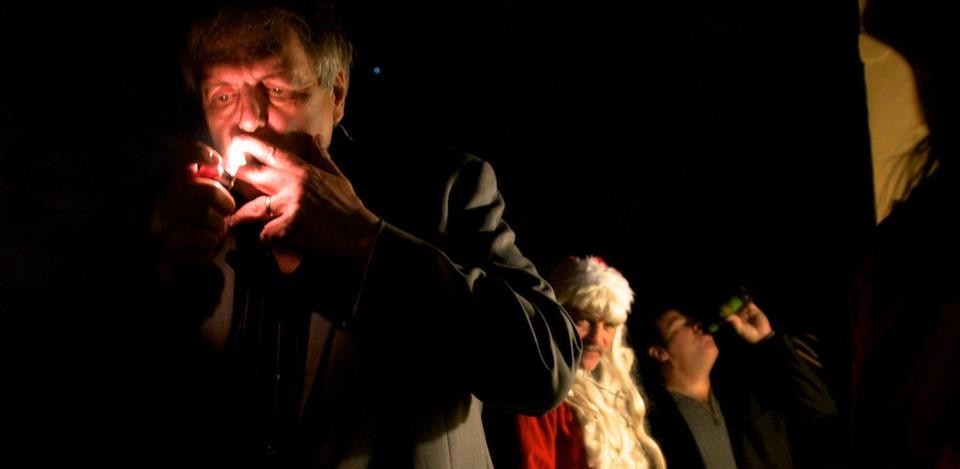
You had no idea you could get there that way.

(February 2015)

Went down to this. Benn on tenor, mostly, plus soprano and flute, with Rick Olson on piano. The energy, heaviness, power and pure jazz made by those two players would have drowned out many a jazz quartet. Rick’s got that Monkish stride and is a natural bass player on the keys, he never once drifted into the flowers or floated, prettily. Not that he can’t, it’s just this night he was the entire rhythm section, plenty of muscle. And Benn is like that incredible saxophonist I used to see at Charlie O’s or on crazy nights at Jax, but even better. You spend half your waking life practicing and you never do plateau, just get better and better, doing new things. Sometimes soloing is like exploring an empty house, looking into dark rooms, flipping on the switch and illuminating all they hold. There’s always another door on the other see waiting to be opened. Three sets of Benn Clatworthy, the bell of his horn two feet away, and you go into a lot of rooms you never even knew were there, even if you’re traipsed through that tune a hundred times. They’re not always pretty, those rooms, but you’ve never seen them before, and Benn always brings you safely back to the head of the tune. It’s just that you had no idea you could get there that way.

Almost Like Being In Love

Actually it’s kinda funny, a jazz critic living next to the world’s worst trumpeter. I woke up from a deep, dreamless sleep by an Almost Like Being in Love so dreadful it verged on profound.  Several takes rolled by till he nailed it, well, splattered it. The melody laid there limp, battered, lifeless. The guy’s got a tongue like a steel toed boot, an embouchure you won’t find in the cheapest whorehouse. Chet Baker dispensed with, he turned to Have You Met Miss Jones, and there was just enough Miles in it that I was going to ask Vince Wilburn Jr. for the name of his attorney. There was an ugly squeak and he stopped to yank his tongue free of the mouthpiece. Then came Clifford Brown’s turn in Whisper Not. You could hear him aiming for Brownian perfection and having a facsimile of it for a second there, the line hanging in the air, glinting in the sunlight, then it came tumbling down in the dust up of a solo, a wreck, alas, that our trumpeter walks away from. Once more from the top. The lines hang in the air, almost flawless for a second or two, and I marvel at where that came from, and the sun shines down and even the birds are hushed. Then here comes that bridge again, oh god.