
Emcee George Reeves at the first Playboy Jazz Festival, 1955.
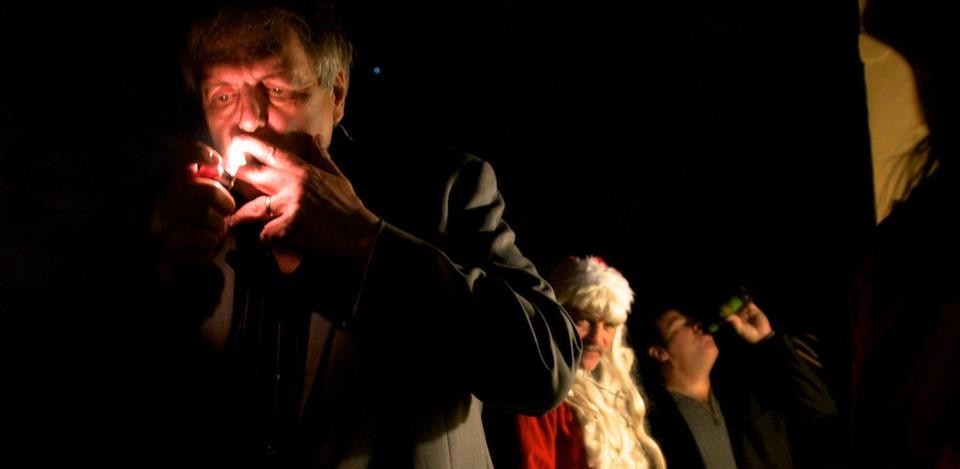
Emcee George Reeves at the first Playboy Jazz Festival, 1955.
(2010)
There’s gotta be something that makes it a blue Christmas. Sometimes it something big, like a war, or a disaster, and sometimes it just a passing friend. James Moody had a lot of friends. He was just that kind of guy. And that makes for a lot of blue Christmases.
You can’t say it was really tragic, though, for Moody was one of those rare jazz icons whose music and life wasn’t streaked with bitterness, anger, regret. He was the guy that made you laugh. Made you feel good. He was the funny guy that played that gorgeous saxophone. Of course, we forget a lot. Moody, after all, “scarred by racism”, as he put it, split for Europe in the late forties for Europe. He’d had quite a young career—a long stint with Dizzy Gillespie, especially—and packed it up for overseas, where the ptomaine of the slave era racism didn’t poison almost everything it touched generations after Civil War and even a bright New Jersey kid like Moody felt suppressed by its dead hand. If you can’t beat ‘em, split, and he did. Abroad, in more ancient lands, he blossomed. He did great stuff there (look for the killer couple sessions with Frank Foster), but Moody’s Mood For Love was the most famous result. You all know it. You may not even know you do until you hear it. It’s so deeply built into jazz by now, worked its way into the jazz DNA. It’s more than a standard. Like Take Five or Kind of Blue, it’s the kind of thing you could tuck into a space capsule and shoot into space for some alien race to find a zillion years from now and listen to and get an idea of who we are. Or were. That tune was James Moody. And he was just beginning.
He wasn’t in Europe long, just long enough for him to shake out a lot of bad vibes and get tired of people not speaking English, and after a few years home and Prestige Records beckoned. This was New York City in the fifties and baby the jazz was happening in a big way, bigger than ever before or ever since. It was the music’s glory years, full of life and death and genius and fabulous, unbelievable jazz. Moody, a star now—“Mood For Love” had been big, radio big—did a whole string of classic sessions. If you know a jazz fan, they got some of these. We just pulled out a small stack of vinyl, putting something on at random. “Flute ‘N the Blues”—when was the last time you heard anyone play the flute so warm and so down to earth? And dig his “I Cover the Waterfront”, Eddie Jefferson on vocals. Oh Lord. There’s nothing like this anymore either. Not like that “Body and Soul” either. Sure, it’s two generations old, and things and jazz change with the years. But people don’t. And James Moody was that same kind of people his whole career. Listen to that horn. It’s a big huge warm alto sound. Nobody else has that. Nobody had Moody’s sense of humor, or just his way of talking to people, especially an audience. You paid good money to see James Moody, and he wanted to let you he knew that. He never turned his back to his fans. Not even now when he’s gone. Folks that knew him, remember him, the rest of us remember the music. That absolutely personal sound of his. How on alto he made jittery bebop warm and less scary. Or could blow some big bluesy tenor that wasn’t sad and doomed and drunk. How he played earthy breathy living flute, transforming a delicate European thing into something loamy and American. And we remember his voice most of all, a voice that could melt hearts when it wanted to, melt ‘em laughing. That sweet guy, James Moody.
(2014)
At Cafe NELA for Eddie Rarer’s birthday party yesterday. Eddie digs the solid rock’n’roll bands but fooled us by booking a lot of zany–way zany–avant garde acts. Whew. When I walked in the joint the blast of Hookah’s white noizoid sound knocked me clean back out into the middle of Cypress Avenue where I was run over by a Smart Car. Totalled it. I apologized and tried to enter Cafe NELA again. I leaned into the sound and made it to the bar. Hunkered down and clung to my beer and a rogue sound wave broke right on top of me and washed me back out into the street right in the path of a truck mounted on monster wheels so high it passed right over me, and I was standing up. I made it back to the sidewalk and hid outside. But I had left that beer on the bar. I got down on all fours and crawled back in. Hookah was raging, screaming, dissonant, artistic. But there was my beer. I could see it. With sisyphean effort I crawled slowly to the bar and hunkered down beneath it. With one hand I reached up and grabbed my PBR. The can quivered as if alive. The roar of Hookah went on and on and then suddenly, as if the very pit of Hell had opened up beneath them and swallowed them whole, all was silence. The audience burst into applause. It was Hookah’s crowd. They’d dug every blast. I’d survived. Art damage lives.
How cowardly I, a jazz critic, had become.
Went out into the beer garden while the next act set up. It’s a popular place, that beer garden. Full of bohemians, freaks and neer-do-wells. They tell stories, some even true, and wonder about lost hair. The women listen to the men’s aches and pains and roll their eyes. Twenty somethings mention their parents. Sometimes we know their parents. Even are their parents. Gigs are planned and bands discussed and suddenly they all have the munchies. A beeline is made for the Salvadoran place next door. They’re cheap and they’ll even bring your food to you right at the bar. I ate a delicious meal that way one night at Cafe NELA watching Don Preston and a free jazz saxophonist from Philadelphia. Yesterday the nice restaurant lady brought over the huevos rancheros I’d ordered. By the time I’d made it back to them the eggs had been sonically transmogrified into a chicken named Pancho who was now the bar mascot, so I skipped dinner.
Hanging out in the beer garden I suddenly heard the unmistakable guitar playing of Carey Fosse. Very talented guy, that Carey Fosse, trapped between rock and funk and jazz and avant garde. He touches on all of them, mixes them, drops them, picks them up again, makes weird shapes. He rocks rootsily, funks groovily, jazzes swingfully, avant gardes freakily. We stood down in the beer garden where by some sort of Twilight Zone miracle we could hear it all perfectly. Cool. We could hang and laugh and bullshit and rag on each other with a Carey Fosse soundtrack. I said time to go in and watch but Donny Popejoy showed up in a Pabst Blue Ribbon tee shirt easily worth another ten minutes chatter. OK, time to go watch Carey Fosse. He was riffing away way cool. I got to the door in time to see him putting away his guitar. It’s all in the timing.
But he had sounded great outside anyway. Very talented guy, that Carey Fosse. Next–unless I’m missing somebody–Ape Killed Ape was entertaining if drummerless. There was a real rock band on at the end I wanted to see but our colds caught up with us and we fled into the night. Great place, that Cafe NELA. The latest–maybe the last even–in the weirdo loser underground hang continuum. It’s been a long way since Al’s Bar. A lot of water under the bridge. And a lot more cheap beer.

Cafe NELA is at 1906 Cypress Avenue, Los Angeles 90065
(Somebody left a nice longish comment on a Charlie O’s piece I posted on Facebook, and she talked about Jax mostly, and Jack Sheldon there every Thursday, week in, week out, a gig you thought would last forever. It didn’t. (He’s around, just retired.) But I went digging through the blog and found this, originally from a Brick’s Picks in the LA Weekly in 2007, and it brought back memories about times long ago that weren’t even that long ago, but are still gone forever.)
Jack Sheldon was hot at Jax last Thursday. Jennifer Leitham swung the bass line like mad or plunged into these beautifully dense solos with great washes of chords or hanging, aching notes; drummer Dick Weller kicked it up crazily as Joe Bagg finessed coherent melodies (or chunks of Monk) from a piano last tuned during the Eisenhower Administration. Jack just got hotter and hotter, those near perfect solos, the trumpet’s single notes celebrating the tune like Satchmo or just taking off into the bop galaxy. In Glendale of all places. We wandered in for a drink and there was this great jazz, and a table right in front where you could feel the bass thrumming right through you. Stayed way too late…but the jazz experience is like that, you know. Often as not it’ll happen at some local hang, utterly unexpected, where some absurdly talented band plays for a smattering of fans and you, drink in hand, thinking just how lucky you are to be in the right place at the right time for once in your life.
[And this is from a Brick’s Picks a couple years later]
Also want to throw yet another plug for Jack Sheldon at the Cafe 322 out in Sierra Madre. While Jack appears regularly in several spots around town—he’s been doing those Thursdays at Jax forever—it’s his monthly appearances at the Café 322 where he’s consistently the most exciting. Pianist Mitch Forman sets the pace, flying across the keys at insane tempos, going off on melodic tangents, and drummers the likes of Ray Brinker launch into breaks you can hear as you pull into the parking lot. There was a “Caravan” we recall that was breakneck, just crazy, but there was Jack, smiling, snapping fingers in time, waiting for his turn…and when he blew his horn he was right there with them, letting loose beautiful crazy bebop lines. There followed a brilliant, languid take of his unrecorded theme song, “Where Do You Start”, that hushed the house. He sang a couple of the verses, just enough, and blew a couple more choruses on his trumpet. Then came the jokes….

Blowing.
And here’s Jack’s show stopping take on “Where Do You Start”, which he never did get round to recording. We will, he told me, next time. Next time…I’ve heard that too many times from jazz musicians. Jazz exists in the now, on stage, while recordings are little frozen moments. Not the same thing. Till later, when you wish to hell they’d recorded it.
And whether you’re a serious fan or just wondering who the hell this Jack Sheldon was I was forever going on about, you have to see Trying to Get Good. An excellent jazz documentary, lovingly assembled by Penny Peyser and Doug McIntyre, it’s up there with the Monk doc Straight No Chaser, and that is saying something.
Oh wow, I’d forgotten this one. It’s from 2008, only a few months before the Wall Street apocalypse that pretty much wiped out the old L.A. jazz scene. I’d written a longish review of a Tigran Hamasyan show as the lede of a Brick’s Picks column and it made an unexpected splash, splashing as far as Armenia (via Glendale) and I got a call from the Armenian Reporter asking if I could do an expanded version for their paper. The money was several times what I received from the LA Weekly. Plus it’d also appear in the Yerevan edition and I could stare at a column with my byline and a completely incomprehensible alphabet. I’d walk the streets of Glendale with my head held high. I’d be one hip dude in Fresno. The link is long gone, though. As is the paper. As is the whole jazz world I lived in then. Gone. Just memories.
But goddam those were the days. I’d jump in my fancy car and hit two or three clubs a night. Do that a couple nights a week. There were that many clubs and that many players and that much action. It was a whole different vibe then, with no cover charges and four sets a night and you could come and go as you pleased. People spent cash and credit like it was going out of style, which it did, come that autumn. That was a fall that really fell, man. That jazz scene — my jazz scene — never recovered. Jazz became an untenable business model. It’s back now, but so different. Hefty cover charges and strict show times, and that link between the players and patrons is sundered. No longer can you banter with the musicians on stage or even off, you can’t or heckle no matter how good naturedly, you can’t even wander up and drop a ten spot into the tip jar after the greatest sax solo you’ve ever heard. Don’t even think of calling out a request. It’s a Jazz Bakery world now, very formal. It’s art and concerts and deadly serious and no talking it’s a shame. For me, anyway. I feel vaguely uncomfortable with all the seriousness. I miss the intimacy of the old dives, and hanging out between sets at the end of the bar cracking wise with the players eyeing the women. Yeah it was low brow, sometimes, and no, it wasn’t Art in a formal sense. It was jazz, real jazz. Informal, spontaneous, nearly always great and sometimes, like this Tigran gig, absolutely brilliant.
Claude Nobs and jazz legend Quincy Jones were at an event in Hollywood recently, reminiscing about their years putting on the annual Montreux Jazz Festival in Switzerland. Someone asked Nobs (he’s the “funky Claude” sung about in “Smoke on the Water”) about the Thelonious Monk Jazz Competition held there recently. The two had been judges, and Nobs remembered that all the young contestants had all played piano so beautifully, showing off their Thelonious Monk, you know, or Herbie Hancock or Bud Powell, each performing one of the master’s tricks. But there was one very young man, Nobs said, Tigre–and he stumbled on the name—who was completely original. Jones agreed. They’d never seen anything quite like him before. The ideas, the technique, the whole approach to the piano and the music—it was all so unique. The originality of genius perhaps. This young man has that. Nobs sighed and shook his head. Just can’t recall the name. Tigre-something. You people here, he’s lives here, you must know the name….
You mean Tigran Hamasayan?
Yes! That’s it! Oh man….if you haven’t yet you must see this young man play the piano! Continue reading
[from a Brick’s Picks in the LA Weekly about 2010]
We don’t know anything about art, really. It’s like classical music or philosophy or poetry or anything really cerebral like that, universes we don’t traipse around much. So we had no idea who George Herms was before we met him. We were occasional drinking buddies at Charlie O’s, always right up front rocking out and applauding too loud and laughing, just really digging the music. He never let on he was famous, like Getty Museum famous. Then one Friday we saw him do his thing at LACMA. There was a band, they took a break, and then there’s George and this huge sphere, an immense hollow iron ball he’d found in the mud somewhere and thought wow, Thelonious Sphere Monk. He finds things that way. And he’s dragging the damn thing around the stage at LACMA, then stops, thinks a minute, and then starts beating on it, making this ethereal music. Freaky. After a while he dragged it off again. For some goddamn reason it was the coolest thing ever, Beat beyond belief, and the band had to blow their asses off afterward to get anywhere near the space he’d taken us.
Well, REDCAT has given him three nights to get to that space again. He’ll be doing the sphere thing, his legendary spiral staircase thing, he’ll be assembling some sort of mondo clarinet out of throwaways, oddities and detritus. He has two incredible bands to score this madness…Theo Saunders & his Lesstet (including Azar Lawrence, Chuck Manning and Henry Franklin) doing mad things with Monk and Trane and Saunders, and the Bobby Bradford Mo’tet doing “Sideman”, one of our fave tunes ever. Herms calls the thing his Free Jazz Opera, and talks of Horace Tapscott and John Carter and Ornette and, well, get him going he can go on and on. He’s breathed this stuff for fifty years, inhaling jazz and exhaling creativity. This will be a real happening, people, each and every night.
[from a Brick’s Picks in the LA Weekly c. 2009]
Trumpeter Bobby Bradford brings his Mo’tet back to LACMA on Friday. Sure, Bradford has major avant garde credentials; his work with John Carter was way out there. But he is always close to the source, with Satchmo just an arm’s length away, and his band sounds so positively genuine you know that his jazz isn’t something purely cerebral, not just art, but deeper than that, something that really swings. There’s no genre to file the Mo’Tet under; not bop enough for Charlie O’s, but not conceptual enough for the way hip art crowd. But he gets serious players like Chuck Manning, and serious fans, like artist George Herms. If you’ve hung around the coolest joints for the past several decades you know Herms, he’s always totally into it, but this time he ain’t watching the show…he’s part of it. Creating what, we have no idea, but his crazy work—just things he’s found combined with other things he’s found that he somehow turns into cool, new things—somehow matches the whole feeling exactly. It’s a real live happening. Be there.
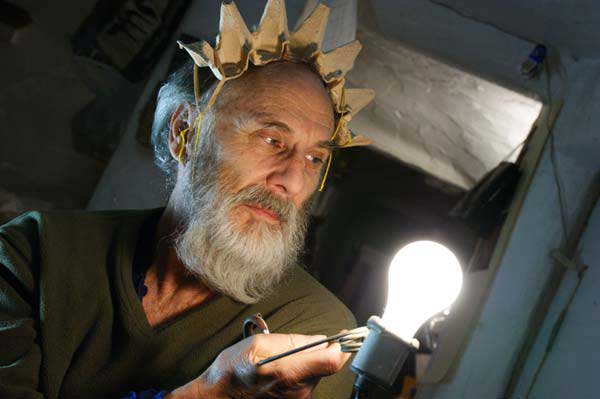
George Herms and light bulb. (Photo by Wilder Herms)
It’s Thelonious Monk’s birthday today. He was born on October 10, 1917 which would make him a zillion years old almost. Hard to believe. You listen to a Monk tune and it sounds now, right now, not a zillion years old. Trane is like that too. They were both from North Carolina, a hop, skip and a decade apart. People don’ t come from small towns in North Carolina and change music forever anymore. Those were different times.
I never saw Monk, something I’ve always regretted. I have the documentaries, Straight, No Chaser and the others, and watch him play, hear him speak, marvel at his dancing crazy circles across the stage. I think man, if only I could have been there. I could have seen him, in his later years, but I was nowhere near hip enough. It takes age to realize what how unhip you’d been as a kid. Unhip at least to what had been around since before you were born. You always catch on too late. But then I dove in deep. A zillion CD’s, listening all the time. The movie Straight, No Chaser. The book Straight, No Chaser. I still don’t have all his albums, there are so many. What an amazing string of releases, across what, four labels? Blue Note, Prestige, Riverside and a big fat deal with Columbia. His music—the tunes were terrific, Monk could write a memorable melody to say the least, and his whole approach to the piano was kind of crazy. Powerful fingers plonking out big crashes of chords, or hanging above the keyboard, waiting to pounce. Then he’d whomp a comp so hard it might startle a more fragile band, but his players dealt with it, thrived on it, though at times might have been confused by it. And I loved the way he’d tinkle the keys between those whomps, laying out the melody with big fat notes, like Count Basie notes but lurching and sudden and surprisingly sensitive. I loved his striding swing, a stride you don’t hear anymore and probably didn’t hear much then. But Monk loved to stride. And then there were the ballads. They lilted in their own way and broke my heart. On Monk Himself, I’d listen to all those out-takes of Round Midnight, one try after another, the man struggling to come up with exactly the music he wanted. Finally, beautifully, it emerges. It’s almost spooky. The album was recorded on April 12 and 16, 1957, but if you wade through the liner notes (this was back when I waded through liner notes) it says how actually that was from a late night session on April 5. The studio was in New York City somewhere, I’d have to dig out the liner notes for the street and borough. About that exact same time, an hour south along the Jersey shore but closer as a crow would fly, I was being born. A nice coincidence. No significance, but a nice coincidence for me, anyway. I thought about telling someone but never did. They wouldn’t get it. I just listen to Monk laboring through Round Midnight and imagine Mom laboring with me. I was a rough birth, a huge kid, her first. They used forceps back then, just squeezed and pulled as she squeezed and pushed. Finally, about the time Monk worked out the melody, I emerged. He played, I bawled.
I think about this a lot as I listen to Monk. I don’t dwell on it, but I think about it.
Back in 2006 some hip brewery in northern California came up with a rich brown ale and called it Brother Thelonious. I can’t remember why they called it that, or what was in it, but I remember it was bitter and dark. One of those Belgian things. You can still buy it. I see it at jazz parties, sometimes, though it ain’t cheap and jazz people are so I don’t see it that often. The brewery had a Brother Thelonious release party in Santa Monica in 2006. (Can a beer have a release party?) The Monk Institute provided the music..Walter Smith III and I believe Ambrose Akinmusire were featured soloists. Maybe even Gerald Clayton. They didn’t look too thrilled performing at a beer party. The tunes were all Monk. A little restrained, maybe–the Institute keeps a tight leash–but then the marketers didn’t want to scare the folks. Monk done Monkishly can still scare the folks. We got several bottles of the ale–they were handing them out–but they were guzzled by lushes at our Christmas party. I recall them discussing Monk in slurred admiration. We also got the cool poster. It still hangs in the kitchen. Been there six years now. Happy birthday, Thelonious. If it hadn’t been for you I’d never have become a jazz writer. If it hadn’t been for you I’d never have been. Well, not really, but there hasn’t been a birthday of mine in years that I haven’t listened to that final take of Round Midnight.

Free advertising.
Listening to Jackie McLean’s Old and New Gospel. Ornette’s demented trumpet here reminds me of the time I was down on Degnan in Leimert Park going back and forth between the World Stage and Sonny’s Spot. There was some pretty Ornettish trumpet blowing going on at Sonny’s, though I think they were aiming for Miles. It’s a difficult instrument, the trumpet. I headed back to the World Stage where Azar Lawrence was blowing his head off on tenor, utterly mad, and the vibe in the room got really deep. Nate Morgan’s hands ran blue pirouettes across the keys, crazy and beautiful and perfect. Afterward Derrick Finch sat at the piano and man, what a player. A lot of that old stride in his style that night. Richard Grant picked up his muted trumpet and played some absolutely gorgeous horn. Beautiful player. There was a fast “Autumn Leaves”. A Miles tune. Some others. Bass player joined in for one before splitting. Then as a duo again they worked out two ballad interpretations: “Giant Steps” and “Confirmation”. Finch finally had to leave and the few of us left in the room walked outside. We hung out front on the sidewalk a bit, Finch talking about his jazz hopes and dreams. Big dreams. This was before the recession and everything seemed possible. Then it was time to go. As we were getting into our cars, you could hear Grant in there alone, blowing another “Autumn Leaves” into the empty room.
Derrick Finch handed me his business card that night. I just found it again, by chance, digging through a desk drawer. It brought all this back. I pulled it out of the drawer and tucked it into a folder full of obituaries and memorials, then put it aside. Things stuck in folders tend to be forgotten. But every time I drive east on the I-10, past the wind farms and Palm Desert and into all that nothingness, I’ll remember that card, and that conversation, and Richard Grant blowing the saddest, loneliest “Autumn Leaves” you ever heard.
(First paragraph was from 2005…the second added in 2009, after Finch’s death in a car accident near Palm Springs.)
Had a nice long chat with Don Preston yesterday. I was at Rockaway Records selling some cds and he was there waiting for his overheated car to cool down. He asked the clerk if they had any Mothers of Invention memorabilia. The guy said they do sometimes. Don said thanks. Don’t think the clerk knew he was talking to one of the actual Mothers. Somehow George Herms came up, and Bobby Bradford and Chuck Manning and Elliott Caine. Mutual friends. Odd gigs, holes in the wall, recording plans. On the way out I gave Don a lift to his car a block away. Met his wife.
Way before L.A. and Paul Bley and Frank Zappa, Don used to play with all the Detroit cats, Elvin Jones and Tommy Flanagan and Yusef Lateef. He’s from Flint, though. I should have asked him about that. My pop’s family was from Flint. I had a piano playing uncle Carl who was quite the prodigy. There’s a recording of him somewhere going mad on Gershwin. Alas, he got his start playing speakeasys and it did him in, eventually. But there’s a possibility that my sodden thirty something uncle and a teenaged Don were in the same place somewhere in Detroit in the late forties. Somewhere people were playing jazz on a piano. One of those meaningless little might have beens that hang in the air for a second or two, then disappear.
 Brick's Picks