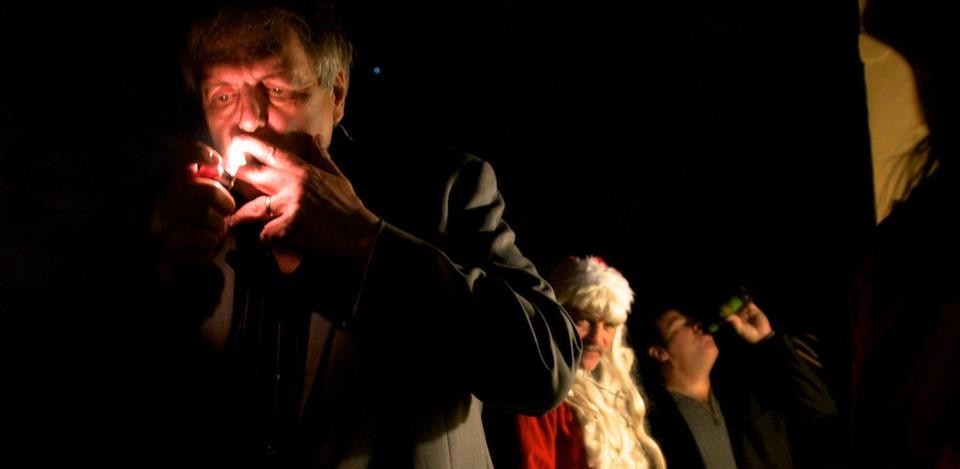
Actually it’s kinda funny, a jazz critic living next to the world’s worst trumpeter. I woke up from a deep, dreamless sleep by an Almost Like Being in Love so dreadful it verged on profound. Several takes rolled by till he nailed it, well, splattered it. The melody laid there limp, battered, lifeless. The guy’s got a tongue like a steel toed boot, an embouchure you won’t find in the cheapest whorehouse. Chet Baker dispensed with, he turned to Have You Met Miss Jones, and there was just enough Miles in it that I was going to ask Vince Wilburn Jr. for the name of his attorney. There was an ugly squeak and he stopped to yank his tongue free of the mouthpiece. Then came Clifford Brown’s turn in Whisper Not. You could hear him aiming for Brownian perfection and having a facsimile of it for a second there, the line hanging in the air, glinting in the sunlight, then it came tumbling down in the dust up of a solo, a wreck, alas, that our trumpeter walks away from. Once more from the top. The lines hang in the air, almost flawless for a second or two, and I marvel at where that came from, and the sun shines down and even the birds are hushed. Then here comes that bridge again, oh god.
Category Archives: Jazz
Pro Drum Shop
There’s a good piece by Alison Martino in Los Angeles magazine–The Beat Goes On at “Wrecking Crew” Hangout Pro Drum Shop–and it got me to reminiscing. About how I used to drop in the Pro Drum Shop regularly, whenever I needed sticks or I broke something. Loved the place. Used to almost feel like a real drummer buying parts in there. I remember the time I said I needed a new drum stool. I got the stare. You need a new throne, he said. I said yeah, a throne. It was a great throne, pneumatic even, at a great price, even though I was an idiot. Maybe there was an idiot’s discount. I remember too they had one of Gene Krupa’s old kits outside hanging over the door for years. Well, that was the story. I chose to believe it. It fit too perfectly, viper Krupa’s drum kit hanging there, high above the ground, in the middle of Hollywood. And that was sacred ground there for drummers. You walk in where Art Blakey walked in, Buddy Rich sauntered in, and Billy Higgins, and Ray McKinley, and Max Roach and Elvin Jones and Mitch Mitchell and Willie Bobo, all of them. I used to think that my hero Davey Tough, epileptic as I am, walked in there too, but no, he was gone already before they opened their doors. But at the time I thought so, and that’s what counts. You’d see major players every time you were in there. Famous cats, session cats, cats I’d never heard of but they’d whisper about behind the counter. Serious cats. It was drum heaven, though an Olympian sort of heaven, full of heroes and legends. It still is, though I don’t play drums anymore. I’m an interloper there now, a spectator. No reason to go there at all. Yet even now when I go to the Union Hall for one of the big jazz bashes I’ll usually walk across the street when the booze hits me and step on in. It hasn’t changed an iota. I’ll wander about the confined quarters looking at the drums, the new ones, the ancient ones. The congas and timbales. The weird looking lopsided kit like something out of the Jetsons. The snares and high hats and gorgeous cymbals. I’ll run my fingers across the rides and crashes and feel the scalloped metal and wonder about the secret formula that makes them sing so, and if they made cymbals like this when Turkey was the Hittite Empire, if cymbals are that old, and if drumming is the world’s oldest profession. Well, second oldest. And then there’s the sticks. So many kinds of sticks. I’ll reach in and pick up a pair and paradiddle the air like an idiot again. Then I’ll put them back, and I’ll sigh, and ask myself why I ever decided to be a writer instead.
Herman Riley in 169 words
(LA Weekly, 2005)
Lockjaw and Prez made him pick up the saxophone. This was New Orleans. There was a teenaged “Iko, Iko”, the very first. By ’63 he’s in L.A., playing Marty’s every night, and players—Sonny Rollins, everybody—dropping by, sitting in. Steady work with Basie and the Juggernaut and Blue Mitchell. Twenty years with Jimmy Smith. A million sessions for Motown and Stax, and first call for a slew of singers—that’s where you refine those ballad skills, with singers. Live he slips into “In A Sentimental Mood” and everything around you dissolves. There’s just his sound, rich, big, full of history, a little bitter, maybe, blowing Crescent City air. He gets inside the very essence of that tune, those melancholy ascending notes, till it fades, pads closing, in a long, drawn out sigh. You swear it’s the most beautiful thing you’ve ever heard, that song, that sound, and you tell him so. He shrugs. “It’s a lifetime of experience” he says, then calls out some Monk and is gone.
Jax
Jax in Glendale has shut down. I don’t think they had booked much in the way of jazz in years, though they certainly did at one time. I loved the place back then, tables so close you could stare right up into a horn’s innards and had to duck the spit valve. Saw moments of jazz brilliance there, incredible things. Wrote up a lot of Jax gigs in Brick’s Picks too, even filled the place on a couple occasions. Last night we were just remembering all those Thursday Nights with Jack Sheldon. Where do you start, Jack would sing, how do you separate the presence from the past? How do you deal with all the things you thought would last, that didn’t last? He’d lift his horn to his lips and solo, a beautiful take on the melody, exploring the tune, the room, his trumpet at last fading into air, just air, and then nothing. Outside Glendale was deathly still at 2 am, unaware that anything had happened at all. Jazz is a music of the now, improvised, unrecorded, leaving nothing but memories. Then the joints shut down and you drive past and remember. Where do you start?

Hearing the music from inside
Man, we were out late last nite–saw four great loud bands at Cafe NELA, the hangue de la hangues, to quote Le Figaro–and then got up this morning in time to trek down to the Lighthouse in Hermosa Beach. The Hermosa Beach Pier is probably as far as you can drive within Los Angeles County from our pad in Silver Lake without crossing any serious topography, but it was an easy enough drive, and there were 69 available spaces in the parking lot (according to the digital sign out on Hermosa Avenue), which is much cheaper than parking in Glendale, seriously. Plus the Lighthouse had no cover, cheap eats, good bloodies and a band so goddamn good I nearly burst into tears when they burst into Monk. It was Chuck Manning‘s gig, and he is one of those cats whose tenor chops just get better and better, and he had with him Theo Saunders on piano who was on fire, especially this stunning, extended solo on Footprints that is simply beyond my writing chops to describe. Just profound shit. It certainly put the heat on whoever followed it, but Sal Marquez came in with a beautiful, searching almost spooky solo on trumpet. Hell, I don’t know if I’ve ever heard a solo like that before. Maybe I just haven’t been around enough, or maybe it was really that special. I can still hear it as I write this, the notes floating in the mental ether, hardening into long term memory. Chuck followed, roaring, getting the crowd riled up and yelling hey’s and alrights on this, the sabbath of all sabbaths. Then bassist Chris Conner laid into another of his superb solos. His ax is like three hundred years old, a lovely thing, and the ancient warmth of its sound seemed to double in that room. No one ever talks over Chris’s solos, everyone listens and breaks into applause. I did, loudly, probably too loudly. Then Joel Taylor, on drums, came in behind him, first under and inside Chris’s solo, and then in his own tumbling interpretation of the tune that was exciting to watch. Finally all came back in on the head and played it out, swirling and melodic, the melody shining. Amazing how much music you can find in such a deceptively simple little tune. The audience was ecstatic. The set was over.
We only caught the last set and a half, but it was perfection. It was real. It was jazz, genuine jazz, which I’d been craving like you cannot believe. A room full of old pals, too, refugees from better times, we sat and listened, eyes closed, hearing the music from inside and wishing it could go on forever.
Frank Sinatra, Jr.
Frank Sinatra, Jr. has died.
He was the nicest guy, everybody said, and that means a lot in a business where not everybody is the nicest guy. He used to come to Catalina’s every once and while, the jazz spot in Hollywood, with his excellent orchestra and fine arrangements. He always got great reviews. It’s a great band, Don Heckman told me, and he’s a great guy, you should interview him. But I managed to miss him every time. Still, I figured the next time around I’d get an interview with him. Not talk about his dad, either, not the usual thing, but to talk about him, Frank Sinatra, Jr. Write up a nice story for the LA Weekly. But then there was a new editor, and he probably had no idea who Frank Sinatra, Jr. even was, and I was burnt out and didn’t feel like fighting with another new editor. So I split the gig and the interview never happened.
Now it’s too late.
I hadn’t actually remembered any of this until now. That’s probably the way it usually is, though, you never remember till it’s too late. I wonder how many of life’s potential happenings slip by like that, things that never bothered you much until you realize they can never happen. It’s not like you screwed up, really, it’s just that you never got around to it. Something always got in the way, and then it’s too late, and you dwell on it a little too much, and it becomes much better than it ever really was. A half assed notion becomes a tragedy, something to talk about half sloshed before your wide eyed friends, like a Frank Sinatra song a few drinks into the chorus, a little story I think you oughtta know.
So rest in peace, Frank Sinatra, Jr. It was a long and musical and quiet career. The public scarcely even knew. That was fine with you. No riding through desert towns with Ava Gardner, shooting out store front windows with a .38. Instead you buried yourself in music, working three times as hard as the guy off the street, singing, conducting, writing, being yourself. A life of pure big band creativity. A good thing.
I wonder if you’ll wind up out in the desert anyway, though, if they will lay you down by your old man. The desert is beautiful, hushed and spare, a dry wind blows through the poppies and the keening of far off coyotes can sound like horns in the night air.
Ligia
Woke up with a tenor saxophone solo going through my head and I can’t remember whose and it’s driving me nuts. It’s just a fragment, fifteen or twenty seconds of somebody blowing something really nice. I can’t really even hear the rhythm section. I’m not one of those cats who wakes up hearing a Hank Mobley outtake and recognizing it. I know guys like that, though. Most of them are players. Jazz players know everything about jazz. Well, they don’t, not everything, but to a layman they might as well, we can’t tell the difference. The other kind are jazz critics. Not all of them, but the serious ones. The encyclopedic Scott Yanows and Don Heckmans and Kirk Silsbees and Richard Ginells and Tom Meeks et al of the jazz universe. We’d all be hanging together in the Playboy Jazz Festival press room looking expertly and the conversation would turn to jazz players, then jazz sessions, then jazz sides, then jazz solos, then outtakes. That’s when you find out that basically you’re just a glorified rock critic. I mean these guys know everything. It’s like listening to baseball fanatics rattle off stats. I’d stay quiet, then slip off and stuff the complimentary beers into my jacket pockets to take back to our seats. You weren’t supposed to take them outside but I hate rules. Give the wrong time, stop a traffic line the poet said. Once I copped a whole bottle of wine. Then went back and got another. You just can’t trust some people. That wine sure went down nice with Wayne Shorter’s set, though. Wayne was so out, I mean he didn’t give a flying fuck if the crowd liked it or not (they didn’t) and his band–Brian Blade on the drums, John Patitucci on bass, Danilo Perez on piano–were so intense, and I’d slipped into the seats they reserve for VIPs and network newsmen and beauty queens…like the beauty queen who sat next to me, in fact. Lovely. We chatted, me and Miss California. It wasn’t a bad gig, really, being a jazz critic.
Stan Getz. Obviously. Ligia. That’s what I’m hearing. The Jobim tune. Once the guitar filtered in I recognized it. João Gilberto’s playing is so instantly identifiable. Well, it is now, though it would have spared me some annoyance if I recognized it an hour or two ago. Of course now the whole tune with guitar and bass and drums is going through my head over and over. But that’s OK, I absolutely love this take. I have it on a comp–think it’s The Lyrical Stan Getz–and not on the original. I can hear the long solo blowing through my cerebral cortex now. There are worse earworms. Ça Plane Pour Moi, for one. You even think of that name and the infuriatingly catchy chorus will skip around inside your skull like a broken record. Like it is now, in fact. Brick, you’re an idiot.
 Richard Ginnell and Scott Yanow surrounded by rich people and looking way too smart for their own good. Playboy Jazz Festival, 2011. Photo copped from scottyanow.com.
A splash of orange juice
Don Edmondson and his annoying little camera. Here I am, mouth wide open, at the Musicians Union on Vine Street in Hollywood. I don’t think I was singing, but have no idea what I am saying, or drinking, but John Altman can’t get a word in edgewise.
I love those Musicians Union gigs. The Professional Drum Shop is across the street. They have one of Shelly Manne’s old kits in there, I think. And at the Union Hall that afternoon Flip Manne knocked me on my ass with a jazz drummer’s screwdriver–eight ounces of vodka with a splash of orange juice. Is that strong enough, she asked? I asked for a little more OJ. You like ’em watered down, huh? I apologized. Shelley liked his with just a splash of orange juice, she said. Well, he was a jazz musician, I said. You’re not a jazz musician? No, ma’am, I’m a writer. I’m so sorry, she said, and dumped out most of the vodka and filled it to the brim with orange juice.
Those jazz dames can be rough.
 A jazz critic explaining to a jazz musician why he plays like that.
Sweet Georgia Brown
Hanging out at a jazz spot with a good buddy of mine and realized he is not a lively seventy something, he’s a livelier almost ninety-something, telling me stories about the summer of ’54. Bird lived one floor up, Prez one floor down. Prez on steamy summer nites in jockey shorts and a pork pie hat; Bird, shy, high, in love, brilliant. Miles would come by, just to hang. I wasn’t even born yet. I ask him what his secret is. He holds up his beer. Good living, he says, and the sax player takes off into Sweet Georgia Brown.
Hollywood Forever
Wandering through Hollywood Forever cemetery on Easter Sunday, past the DeMille family plot, I came across two guys–one English, the other an Angeleno–deep in conversation about Sidney Bechet. Sidney’s not in Hollywood Forever–he’s interred somewhere in France, I think–so why they were talking about him I have no idea, but delighted, I joined in. We talked about what a great soprano saxophonist he was, and what a hellraiser, and what a lousy shot. The French adored him, the Englishman said. But they put him in jail, I said. Yeah, he said, but they also raised him a statue. We laughed. A grieving family around a fresh grave gave us the evil eye. We moved on. More jazz talk. I let drop I’d been a columnist. I know where all the bodies are buried, I said. Well, they were buried everywhere. It’s a cemetery. I did show them where Art Pepper’s ashes lay, in the mausoleum. We talked about what a great alto saxophonist he was, and what a hellraiser, and how he got jail but no statue. I dropped Laurie Pepper’s name, just to be hip. It echoed in the marble corridors. Outside on the lawn again, we passed show biz people on location for their very last scene. There’s Mickey Rooney, I said. There’s Fay Raye. And there are the Fairbanks, at the end of that long reflecting pool. We stood at its edge, reflecting. Are there any Barrymores in the cemetery, the Englishman asked. Are you kidding, I said. They wouldn’t be caught dead here.
 Brick's Picks